
– Rediscovering the City Through Its Hidden Mountains
By Kazuhiko Miwa
Tokyo’s Ultra-Low Mountains
Episode 2
Atagoyama-Stairway to Success
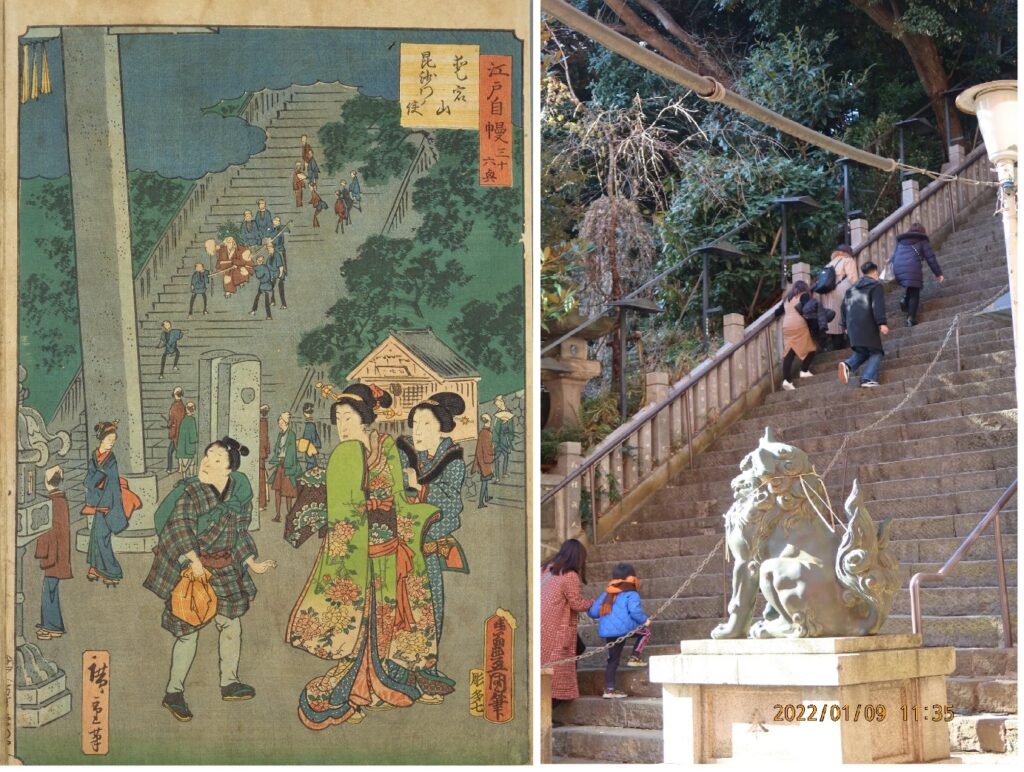
The number of visitors to Atago Jinja Shrine for the New Year is nowhere near that of Meiji Jinja Shrine or Kanda Myojin Shrine, yet it still attracts a remarkable crowd. One reason is the shrine’s steep stone staircase, popularly known as the “Stairway to Sucess,” which has long been favored by office workers hoping for good fortune in their careers.
The staircase consists of 86 steps with an incline of about 40 degrees. That is roughly the angle of a ski-jump ramp. Standing at the top can make your legs tremble. Without the handrails, many elderly visitors would find it difficult to go up or down. It may well be the steepest staircase in Tokyo.
The story behind the “Stairs to Success” dates back to the Edo period. One day, Tokugawa Iemitsu – the third shogun of the Tokugawa Shogunate, was passing below the staircase on his way back from Zojoji Temple. Looking up, he noticed plum blossoms blooming at the top of the hill and reportedly said, “Who will bring me one of those blossoms?”
Everyone hesitated when they saw the steep slope. However, Magaki Heikuro, a samurai from the Marugame Domain in Shikoku, boldly rode his horse straight up the stone steps, plucked a branch of blossoms, and presented it to the shogun. Whether Iemitsu actually exclaimed, “Well done, Heikuro!” is unknown, but the story goes that Heikuro’s feat made him famous throughout Japan and greatly advanced his career.
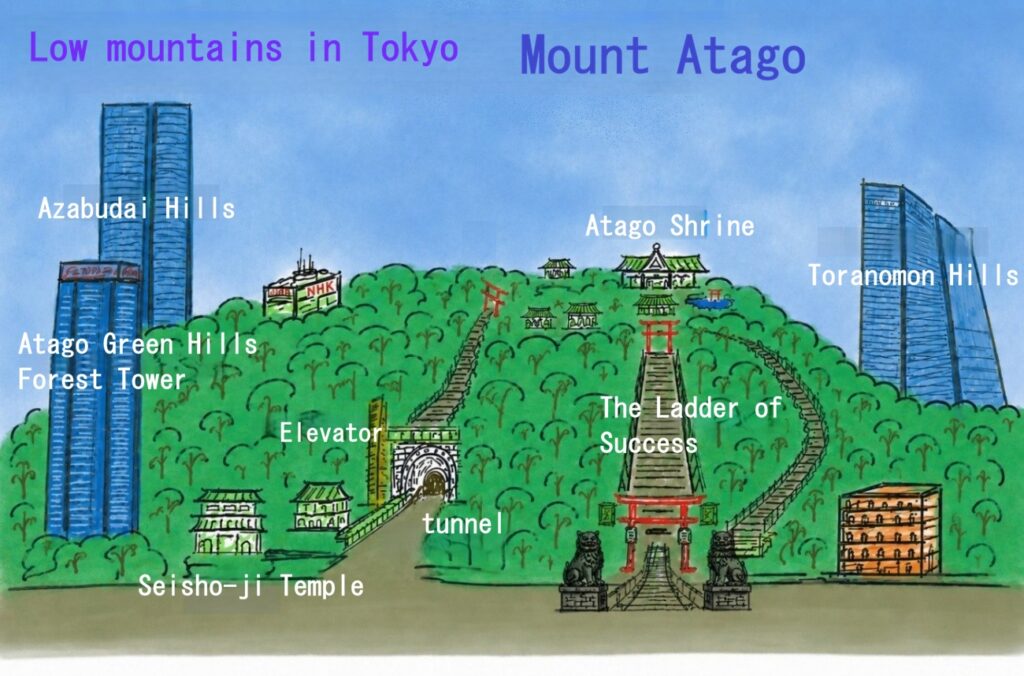
The road in front of the shrine, marked by the red torii gate, now connects Toranomon Hills and Zojoji Temple. Passing through the tunnel beneath Atagoyama leads toward National Route 1, Tokyo Tower, and the recently developed Azabudai Hills district.
Although my old illustration shows only three skyscrapers, the area today is one of Japan’s leading business districts, filled with government offices and corporate headquarters. It is truly a town of office workers.
Many years ago, I ran up all 86 steps in just over a minute.
Unfortunately, it did absolutely nothing for my career.
Later, I learned that climbing the stairs brings good fortune, but descending the same staircase is said to diminish it. Apparently, one should use a different route on the way down.
I ran down the stairs as well.That must have been my mistake.
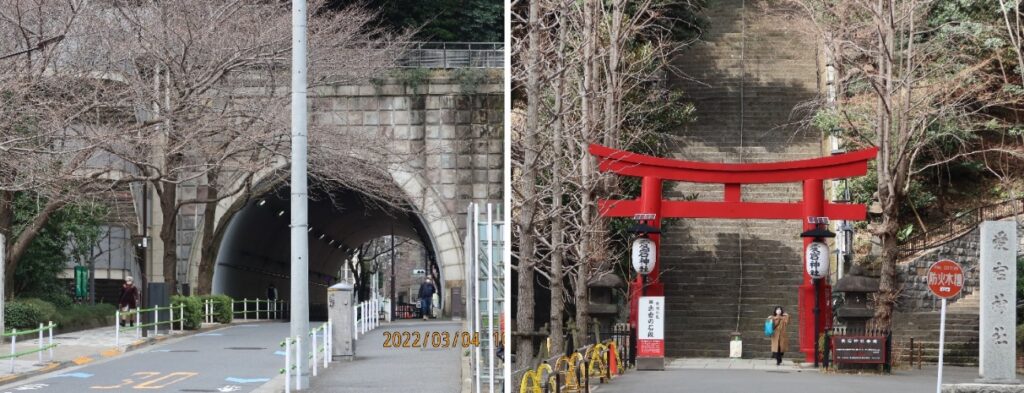
There are several ways to descend from the summit of Atagoyama. One can take the gentler Onna-zaka (“Women’s Slope”), walk through the shrine grounds to the NHK Museum of Broadcasting and use the elevator, or descend the steep slope toward Kamiyacho. Even if you take the elevator, it is easy to reach Kamiyacho by passing through the tunnel beneath the hill.Incidentally, this tunnel may be unique in Tokyo. As far as I know, it is the city’s only road tunnel that passes beneath a natural hill rather than an artificial structure. If any readers know of other examples, I would be delighted to hear about them.
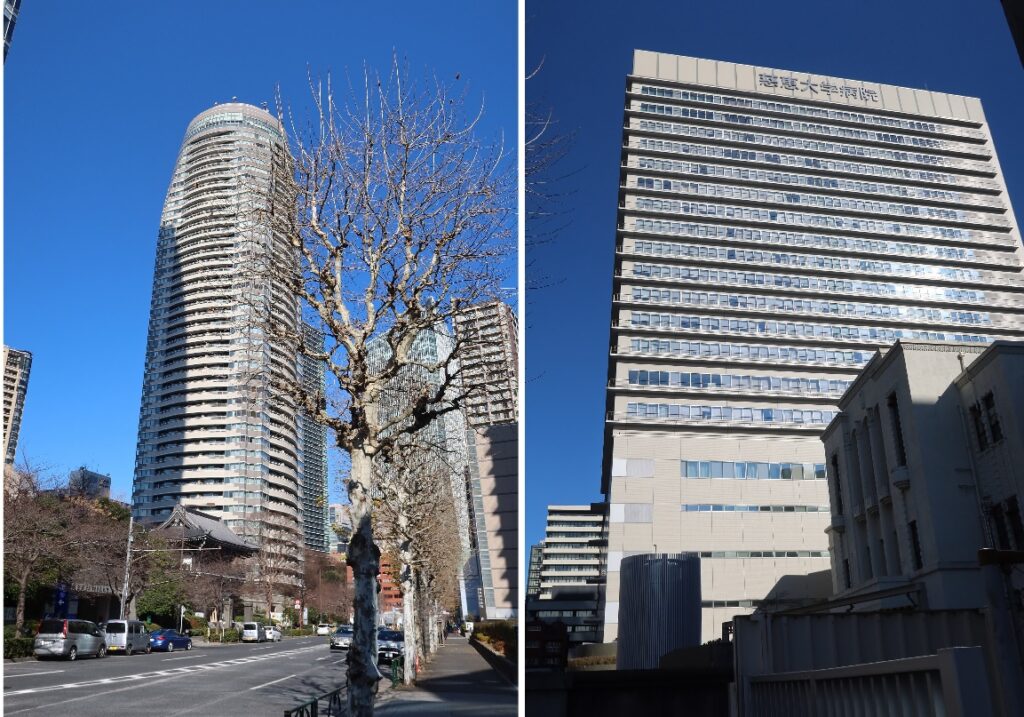
The gate visible beneath the high-rise buildings in the photograph belongs to Seishoji Temple. Although it appears to stand on low ground, the temple itself occupies an elevated area connected to Atagoyama. In earlier times, visitors could enjoy views all the way to the sea. Today, one must climb much higher buildings to look out over Tokyo. During the Edo period, however, the Atagoyama area was among the highest points in the city.
It is said that during the negotiations for the peaceful surrender of Edo Castle, Katsu Kaishu who negotiated the peaceful surrender of Edo Castle, invited Saigo Takamori,one of the leaders of the Meiji Restoration to Atagoyama and showed him the vast city spread below.
“Are you really going to turn all of this into a sea of fire?” Katsu reportedly asked.
Seeing Edo from this commanding viewpoint for the first time, Saigo is said to have accepted the proposal for a bloodless surrender.
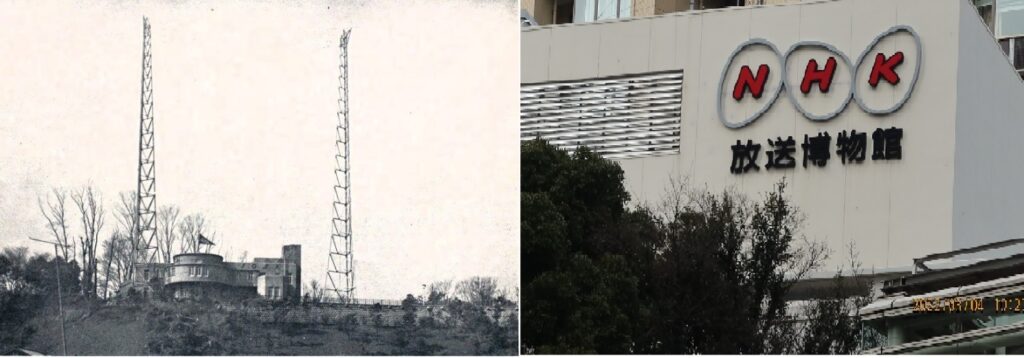
Another historic event took place atop Atagoyama.
“JOAK, JOAK, this is the Tokyo Broadcasting Station.”
These words marked the beginning of Japan’s first radio broadcast in July 1925. Because radio signals were still weak at the time, a 45-meter transmission tower was erected on top of the 26-meter hill to extend the broadcast range.
The site is now home to the NHK Museum of Broadcasting and is affectionately known as the birthplace of Japanese broadcasting.
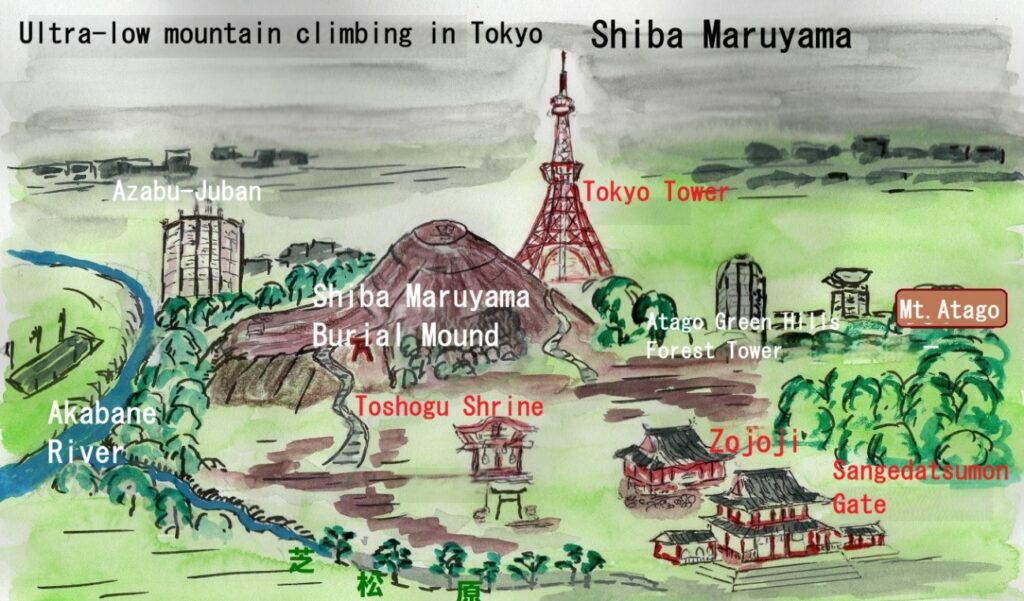
After visiting Atagoyama, I often walk past Zojoji Temple with Tokyo Tower rising in the background and continue on to Shibamaruyama Kofun, the largest keyhole-shaped burial mound in central Tokyo.
The grounds of Zojoji Temple were once enormous. Until 1873, both Shiba Maruyama Kofun and the land where Tokyo Tower now stands were part of the temple precincts.
Few people realize that such an ancient burial mound exists in the very heart of Tokyo.In future episodes, I hope to introduce several kofun hills located along the Tama River.
