
Episode 2-1
Enkū’s Early Life and Journey to Ezo
By Katsuhiro Shimizu
Before tracing Enkū’s extraordinary life of image-making and mountain ascetic practice — an undertaking that can only be described as an adventure — it is useful first to look at the historical age in which he lived and to outline the course of his life.
Because Enkū left behind no personal records such as diaries, studies of his life have traditionally focused primarily on his Buddhist sculptures, known collectively as Enkū Buddhas. Scholars have relied on inscriptions carved on the backs of statues and on a limited number of historical documents, often discussing his life through considerable conjecture while paying little attention to the severe mountain training that occupied him over many years.
However, by drawing upon earlier studies — particularly those of Enkū scholar Teiji Kojima, who established a chronology for nearly 5,400 surviving statues — together with inscriptions found on the backs of sculptures, more than 1,600 poems composed by Enkū, documentary sources relating to temples, shrines, and regions he visited, and extensive field investigations including surveys in mountain areas, the following picture of his life emerges.
It is clear from Enkū’s own signature, preserved in a Buddhist manuscript and reading “Enkū, born in the Year of the Monkey in Mino Province”, that he was born in 1632 in Mino Province, in central Japan—an area corresponding to present-day southern Gifu Prefecture.
Japan at that time was entering a new era. Following the long age of warfare that had continued through the fifteenth and sixteenth centuries, Tokugawa Ieyasu established the Tokugawa Shogunate in Edo (present-day Tokyo) in 1603. The social and political order of what would become the 265-year Edo period was then gradually taking shape.
Various theories exist concerning Enkū’s early life. One important source is Kinsei Kijin-den (Biographies of Eccentric Figures of Early Modern Japan), a widely read collection of biographies compiled during the Edo period by Ban Kōkei. It states:
“The monk Enkū was a native of Takehana in Mino Province (present-day Takehana, Hashima City). He entered the Buddhist order in childhood and lived in a certain temple, but at the age of twenty-three he fled from it, withdrew to Mount Fuji, and later also secluded himself on Mount Hakusan.”
In one of his poems, Enkū wrote:
Has this robe become
a substitute for my mother’s life?
From these sources, we may infer that Enkū lost his mother while still young, entered a temple as a child, and later abandoned monastic life. Yet, even though he regarded his monk’s robe (kesa) as something that had taken the place of his mother’s very life, why did he leave the temple? To answer this question, we must turn our attention to the land where he was born and raised.
Hashima, believed to be Enkū’s birthplace, lies in a delta region between two of Japan’s great rivers, the Kiso and the Nagara. During the early Edo period, devastating floods occurred with unusual frequency, partly because strong embankments had been constructed on the opposite bank in the territory of the Owari Domain. Historical records tell of floods that claimed thousands of lives. Enkū must surely have witnessed the deaths of countless people, including many children. It is highly likely that his own mother also perished in one of these floods.
Although the young Enkū survived and was placed in a temple, the floods continued almost every year. He may well have wondered whether he was truly able to pray for his mother’s repose. Tormented by such feelings of helplessness and grief, he may have decided to leave the temple in search of another path. For many years thereafter, Enkū’s whereabouts remained unknown. Until recently, scholars had generally regarded the period between his departure from the temple and the beginning of his sculptural activities in 1663, when he was in his early thirties, as a blank in his life.
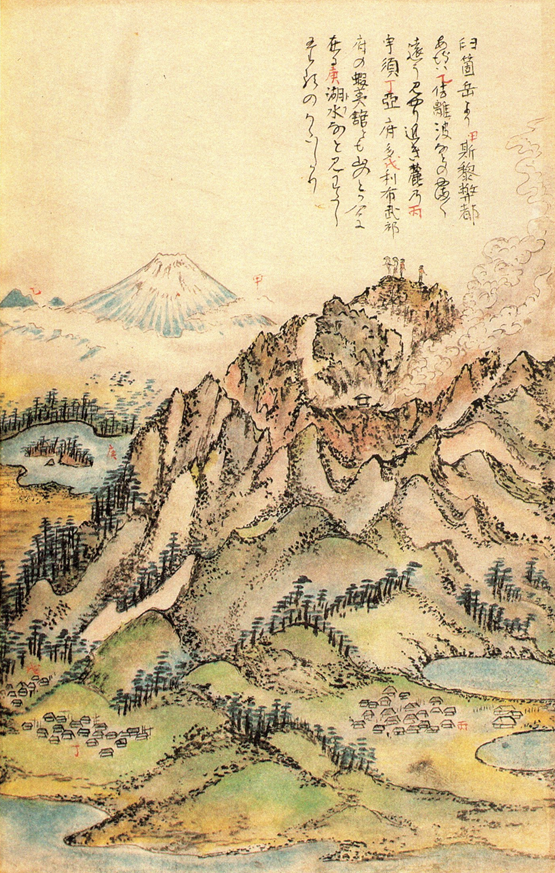
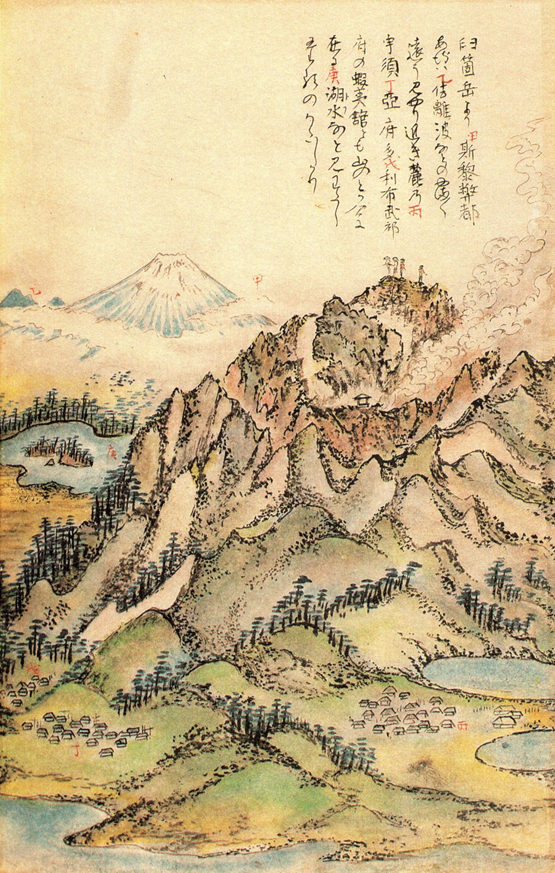
A distant view of Mount Usu drawn by the eighteenth-century traveler Sugae Masumi in Ezo no Teburi.
Beyond the smoking Mount Usu lies Lake Tōya, with Shiribetsu (Mount Yōtei) rising in the distance.
In striking contrast to the uncertainty surrounding his early years, Enkū’s activities after he began carving Buddhist images were remarkably dynamic. Only three years after taking up sculpture, in 1666, at the age of thirty-five, he crossed over to Hokkaido, then known as Ezo, and created Buddhist images there.
At that time, apart from the Matsumae Domain, which governed the southern tip of the island, vast territories inhabited by the Ainu people-the Indigenous people of northern Japan, stretched across Ezo. Much of the region remained geographically unexplored during the early Edo period.
Ezo had recently experienced a series of catastrophic volcanic eruptions. Mount Usu erupted violently in 1663, following the great eruption of Mount Komagatake in 1640. In 1665, Mount Taihei on the Sea of Japan coast also rumbled ominously, and according to Fukuyama Hifu, the official chronicle of the Matsumae Domain, the mouth of a nearby river was uplifted and turned into dry land, causing widespread fear among the inhabitants.
The same chronicle records that sacred images carved by Enkū were placed in halls that the domain ordered to be built simultaneously in settlements along the Sea of Japan coast in 1665. It is therefore reasonable to suppose that Enkū was invited by the Matsumae authorities to carve images and perform prayers intended to pacify the disturbed land.
Moreover, after becoming the first person known to have climbed Mount Usu, Enkū secluded himself in the cave of Koboro, in present-day Toyoura, Hokkaido—a cave also used by the Ainu people. There, he enshrined five statues of Kannon (Avalokiteśvara), each bearing on its back the names of mountains, including Mount Usu.
On the reverse side of the principal image among the five, Enkū carved the following inscription:
“At Koboro Cave in Usu,
formerly a monk practicing at Byōdō-iwa on Mount Ibuki in Ōmi Province.
On the twenty-eighth day of the seventh month, Kanbun 6 (1666),
first ascent of this mountain.
Enkū (with seal).”
This inscription strongly suggests that, before beginning his sculptural activities, Enkū had trained in the vicinity of Byōdō-iwa, a symbolic site of mountain asceticism on Mount Ibuki in present-day Shiga Prefecture. It also indicates that he had already acquired the mountaineering skills necessary to make the first recorded ascent of Mount Usu shortly after its eruption.
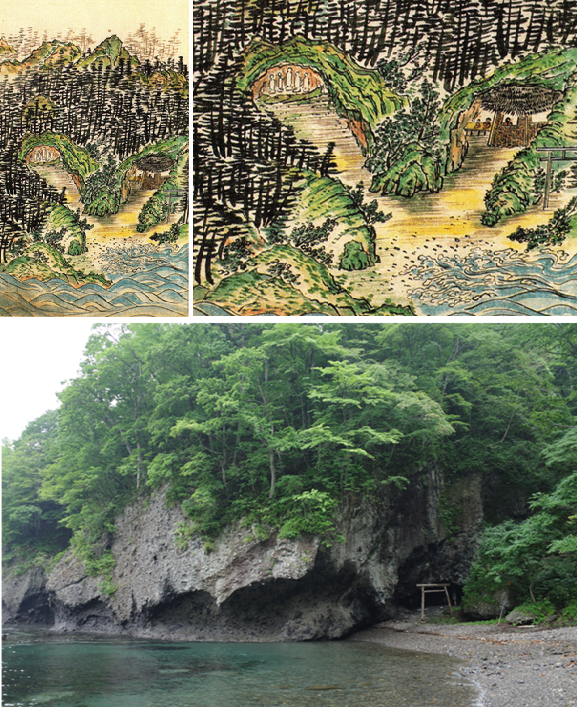
Figure 2-1 (upper): Koboro Cave as depicted in Ezo no Teburi (1791) by Sugae Masumi. The enlarged image on the right includes figures of the Ainu people. Sugae Masumi, an essayist and explorer of the mid-Edo period, rediscovered Enkū’s statues 125 years after they had been enshrined there.
Figure 2-1 (lower): Koboro Cave today. I spent a night there in remembrance of Enkū, while confronting the ever-present fear of brown bears inhabiting the surrounding area.
Located west of Kyoto and overlooking Lake Biwa, Japan’s largest lake, Mount Ibuki is a mountain composed largely of limestone and has long been revered as a sacred peak. Within the mountain are rocky sites such as Byōdō-iwa, which have traditionally served as places of training for practitioners of Shugendō, Japan’s indigenous tradition of mountain asceticism.
By the early Edo period, however, major temples such as Taiheiji, which had once flourished as centers of mountain ascetic practice, had been destroyed during the final stages of Japan’s age of civil wars, partly because they maintained armies of warrior monks. Only a few small temple lodgings remained, and the mountain no longer offered an environment in which one could train as an officially recognized ascetic.
Enkū seems to have immersed himself in the mountains of Ibuki not as a monk, nor as an accredited ascetic, but as “a man belonging to no established order.” Alone, he confronted the sheer rock faces and devoted himself wholeheartedly to rigorous mountain practice. It is also likely that Ōmi merchants, who monopolized trade with the Matsumae Domain and dealt in limestone quarried from Mount Ibuki, played an important role in facilitating Enkū’s journey to Ezo.
#Japan Mountain Day Foundation
#Enku
#Shukendo
#MountUsu
#MountIbuki
