
– Rediscovering the City Through Its Hidden Mountains
By Kazuhiko Miwa
Episode 3: Matsuchiyama – The Hidden Sacred Hill of Asakusa
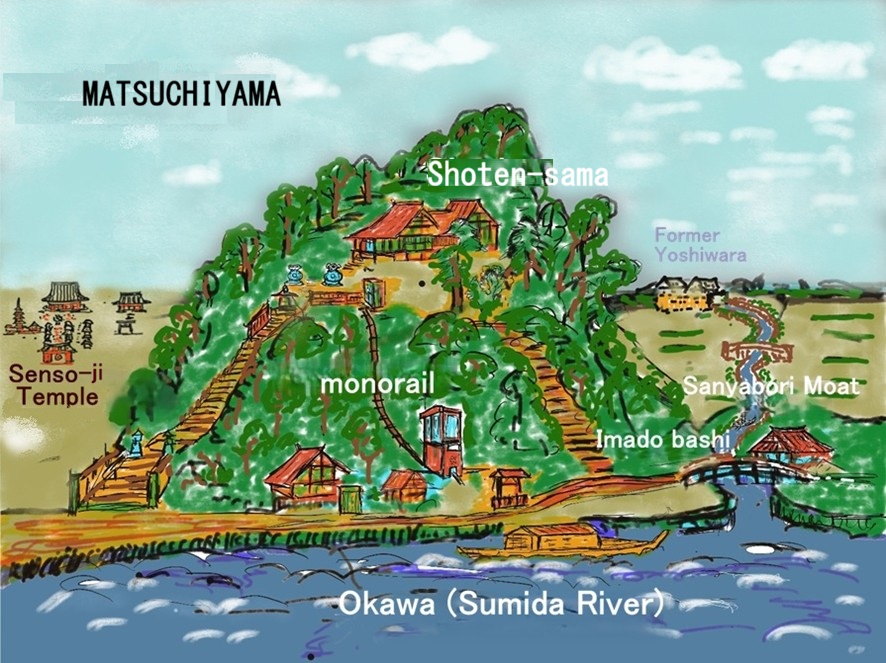
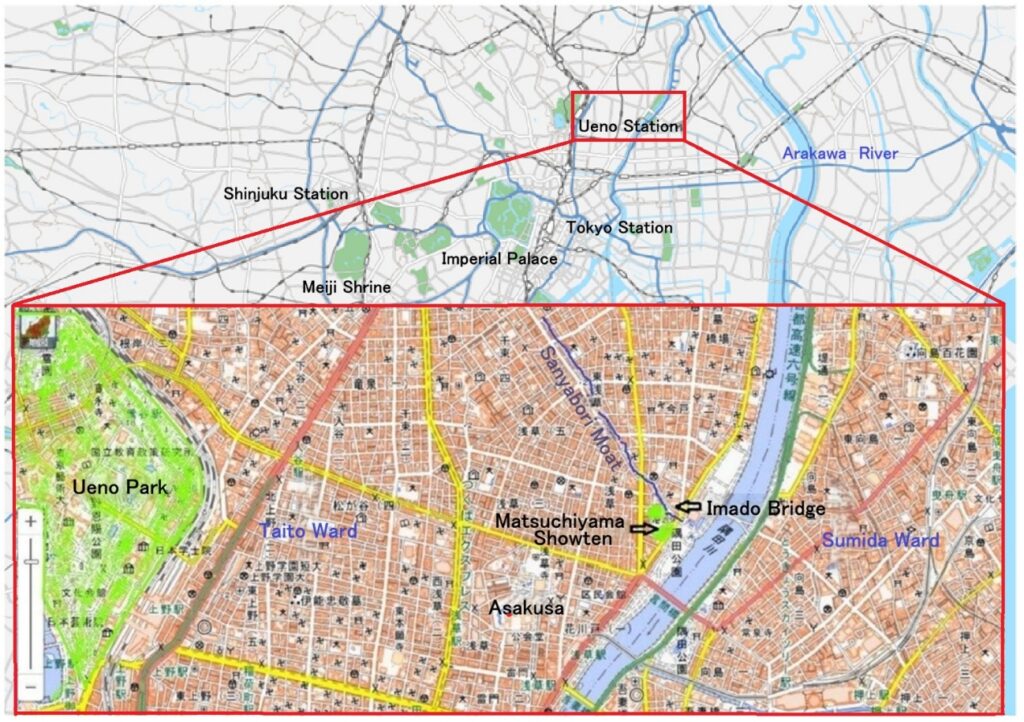
Behind Sensoji Temple in Asakusa, near Imado Bridge, stands a small shrine dedicated to Shoten, the deity of Matsuchiyama.
Asakusa is famous as one of Tokyo’s traditional downtown districts, and there are no prominent hills in the area. Yet Matsuchiyama rises some ten meters above the surrounding landscape.
Today, its appearance is largely hidden by modern buildings. However, in Hiroshige’s ukiyo-e prints, the hill is depicted as a prominent landmark overlooking the great river, the Sumida River.The illustration below is my own attempt to recreate the scene in the style of Hiroshige.
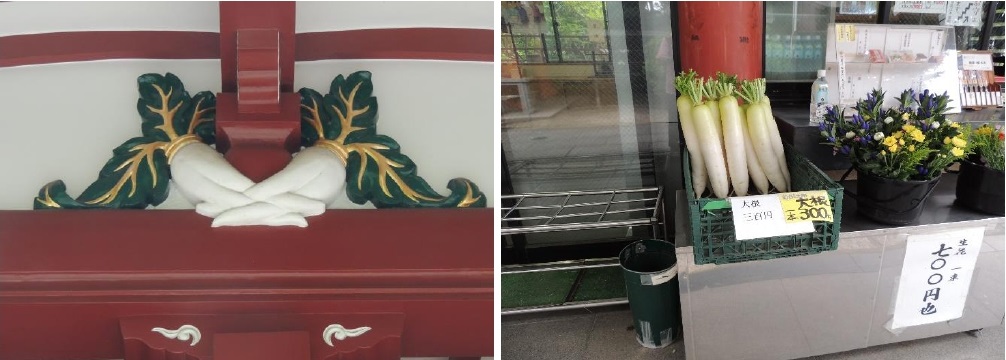
When I visited, many worshippers were offering daikon radishes at the shrine.
This immediately caught my attention.
Carved into the shrine building itself are two crossed radishes. Offering daikon may seem unusual, but apparently it is the proper way to pay respects here.
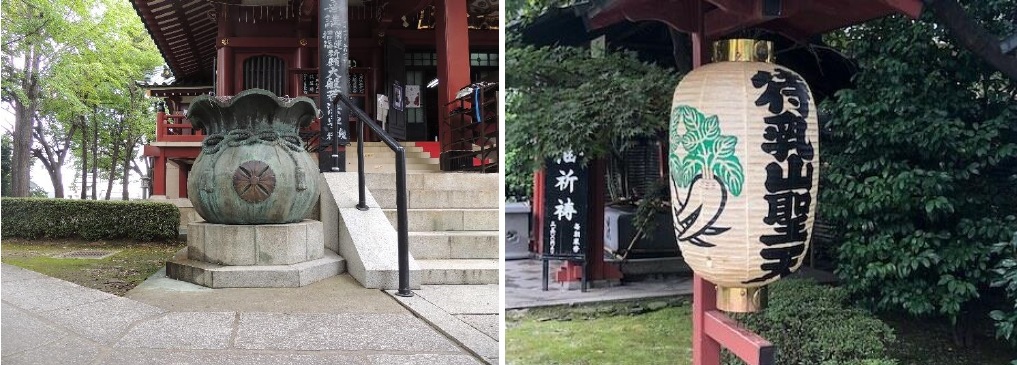
Another curious feature stands in front of the shrine—a giant drawstring money bag.
The symbolism is straightforward: may prosperity flow in abundantly and never flow out again. The symbolism is straightforward enough: may wealth flow in abundantly, and once it arrives, may it never leave.
The shrine is said to grant many blessings, but one in particular is emphasized: harmony between husband and wife.
The forked radishes are officially associated with health and longevity, yet they also seem to symbolize marital harmony.
My own interest, however, lay elsewhere.
I wanted to know whether Matsuchiyama is a natural hill.When I first visited, I confidently concluded that it could not possibly be natural. How could a genuine hill survive in the middle of Tokyo’s low-lying downtown district? I assumed it had been artificially created from soil excavated during the construction of nearby waterways and proudly announced this theory on Facebook.
Later, however, I discovered a problem.
Historical records suggest that Matsuchiyama already existed when Tokugawa Ieyasu entered Edo in the late sixteenth century.
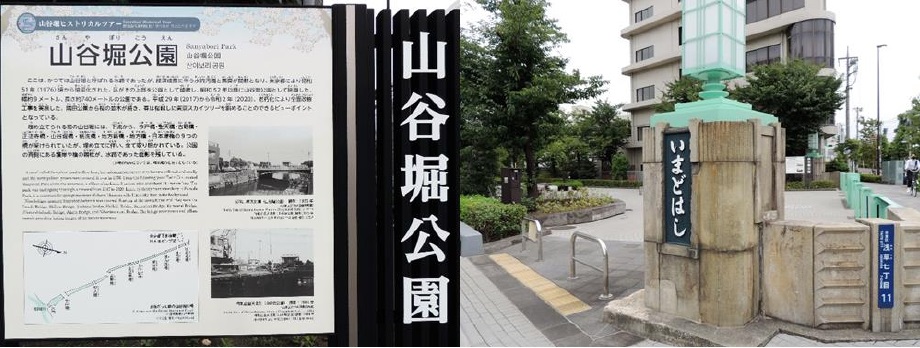
The nearby Sanyabori Canal was constructed during the Edo period, meaning that the hill must have predated the excavation. My neat theory suddenly became much less convincing.
Matsuchiyama was also once known as “Majiyama”—literally, “the hill of real earth.”
Could this name indicate that it was indeed a natural hill?Another clue intrigued me.
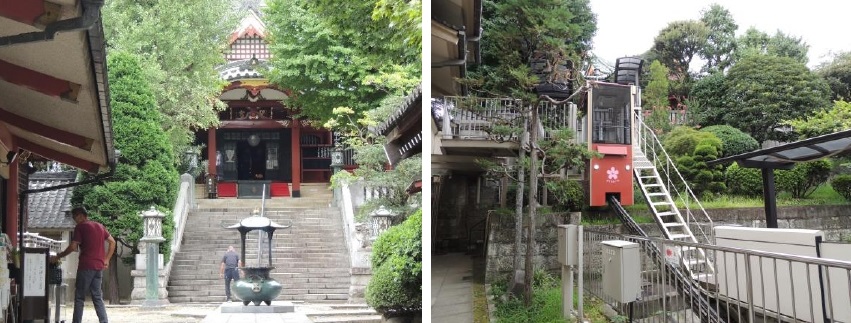
Although Matsuchiyama rises only about ten meters, a small monorail has been installed to carry visitors from the riverside entrance to the top.
As far as I know, only two ultra-low hills in Tokyo have monorails designed specifically to help visitors reach the summit: Matsuchiyama and Asukayama in northern Tokyo.
Perhaps the monorail reflects the aging population among the shrine’s devoted worshippers.
Near the monorail and within the garden, a small portion of the hill’s exposed ground can be seen.If I could find the reddish volcanic soil or dark volcanic ash layers typical of the Musashino Plateau, I might be able to prove that the hill is natural. Unfortunately, the slopes are covered with vegetation, and the geological evidence remains hidden.
Eventually, I turned to geological maps available on the internet.
There I found a possible clue.
The subsurface layers beneath Matsuchiyama appear similar to those found beneath Ueno Hill. Most of the Asakusa area is covered by thick alluvial deposits of mud and clay, but the area around Matsuchiyama seems to contain older terrace deposits associated with higher ground.
From this evidence, I arrived at a rather speculative conclusion.
Long ago, a ridge extending from the Ueno Plateau may have stretched toward the edge of what was then Tokyo Bay. Over thousands of years, waves and erosion gradually removed most of that ridge.Matsuchiyama may simply be the last surviving fragment.
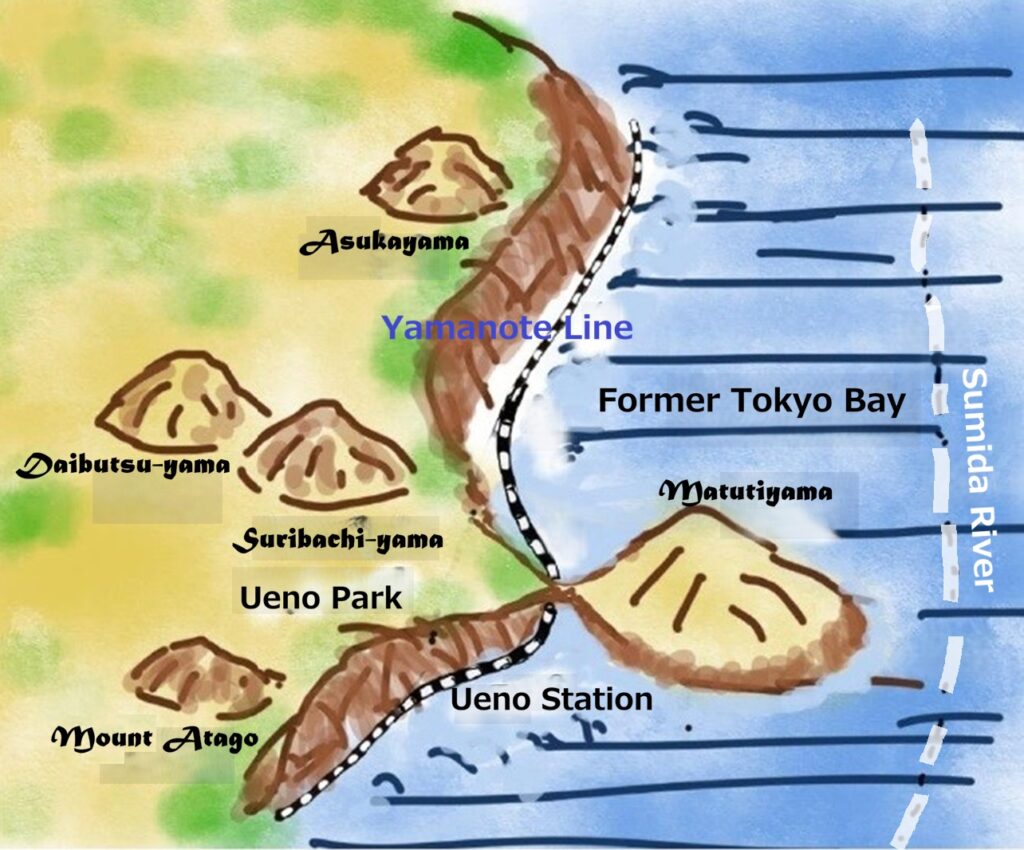
At least, that is the picture I have chosen to believe.
Whether it is actually true, however, I am still not entirely sure.
