
By Katsuhiro Shimizu
Episode 1: The Characteristics of Japan’s Natural Environment and Mountain Worship
Japan is a country of both mountains and sea. Situated to the east of the Asian continent, the Japanese archipelago stretches in an arc into the Pacific Ocean. It lies at one of the world’s most geologically complex locations, where four of the Earth’s tectonic plates converge. The archipelago straddles two continental plates—the North American Plate and the Eurasian Plate—and is strongly compressed from two directions by the subduction of the Pacific Plate and the Philippine Sea Plate. There is no other place in the world where as many as four tectonic plates collide and interact in such a manner.
Because of this geological setting, earthquakes occur frequently in Japan. Approximately ten percent of all earthquakes of magnitude 7 or greater worldwide occur in Japan. Moreover, the active subduction of the Pacific Plate beneath the Japanese archipelago has made Japan one of the world’s most volcanically active regions. Although Japan accounts for only about 0.25 percent of the Earth’s land area, it contains 111 active volcanoes—approximately seven percent of the world’s total.
About 75 percent of Japan’s land consists of mountainous terrain. In central Japan, numerous peaks exceeding 3,000 meters rise in close succession, creating magnificent mountain landscapes. At the same time, however, the country has long been exposed to natural disasters such as earthquakes, tsunamis, and volcanic eruptions.
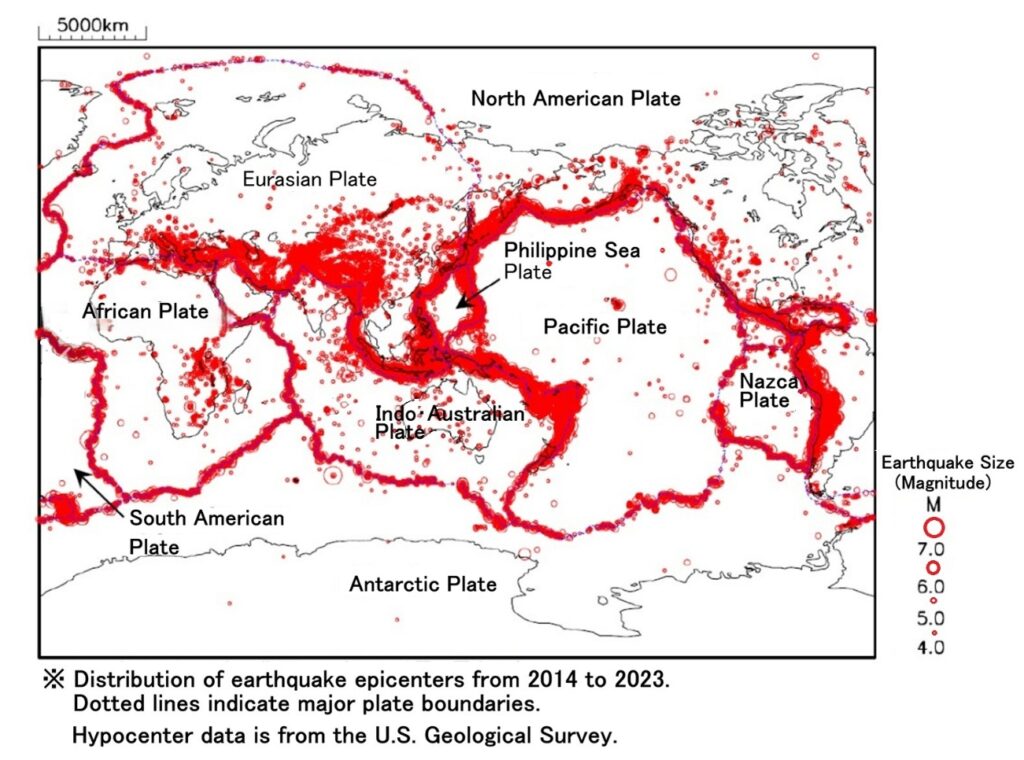
Distribution of the world’s major tectonic plates and earthquakes (Japan Meteorological Agency)
According to the Köppen climate classification, most of Japan belongs to either the humid subtropical or humid continental climate zones. The country is characterized by four distinct seasons, wide annual temperature variations, abundant precipitation, and significant seasonal fluctuations in rainfall.
Thanks to its plentiful rainfall, Japan possesses rich forests and supports more than 90,000 species of living organisms, including some 6,000 endemic species. Mountain resources—such as timber, wildlife, hot springs, and minerals—have been indispensable to Japanese life. Abundant water has also sustained rice cultivation and supported a relatively large population within Japan’s limited land area.
Before modern flood-control and irrigation technologies were introduced from the West, however, floods occurred frequently, while severe famines caused by drought repeatedly struck the country.
Japan’s frequent earthquakes, combined with its abundant forest resources, encouraged the development of wooden architecture. As a result, Hōryū-ji Temple, the world’s oldest surviving wooden building, still stands today. Yet wooden construction also made communities highly vulnerable to fire. Edo, present-day Tokyo, was repeatedly devastated by great fires, making fire another major threat to people’s lives.
Thus, while Japan has received immense blessings from nature, its people have also had to live with the many disasters that nature can bring. Japanese culture and religion have evolved under the influence of both aspects of nature.
Japan is known for Shinto, which developed from ancient folk beliefs, nature worship, and ancestor worship, as well as Buddhism, which was introduced from India via China in the sixth century. In Japan, perhaps more than in many other countries, natural threats have been closely associated with death, suffering, and anxiety. Consequently, the forms of spiritual salvation sought through religion became deeply intertwined with nature itself.
Against this background, religion in Japan developed in distinctive ways. Shinto, with its strong emphasis on nature worship, and Buddhism, which stresses salvation, gradually merged. This syncretic tradition, known as shinbutsu-shūgō(the fusion of Shinto and Buddhism), became widely accepted. For example, Amaterasu Ōmikami—the central sun goddess of Shinto and the mythical ancestress of the Imperial Family—came to be regarded as identical to Dainichi Nyorai (Mahāvairocana), the principal Buddha of Esoteric Buddhism.
Mountains in Japan had long been revered as sacred places possessing spiritual power and as dwelling places of ancestral spirits. Influenced by Buddhism and Daoism, these indigenous mountain beliefs eventually gave rise to Shugendō, Japan’s unique tradition of mountain asceticism.
At the heart of Shugendō are ascetics known as yamabushi, who seek to acquire supernatural powers through rigorous mountain training and employ those powers in religious and ritual practices.
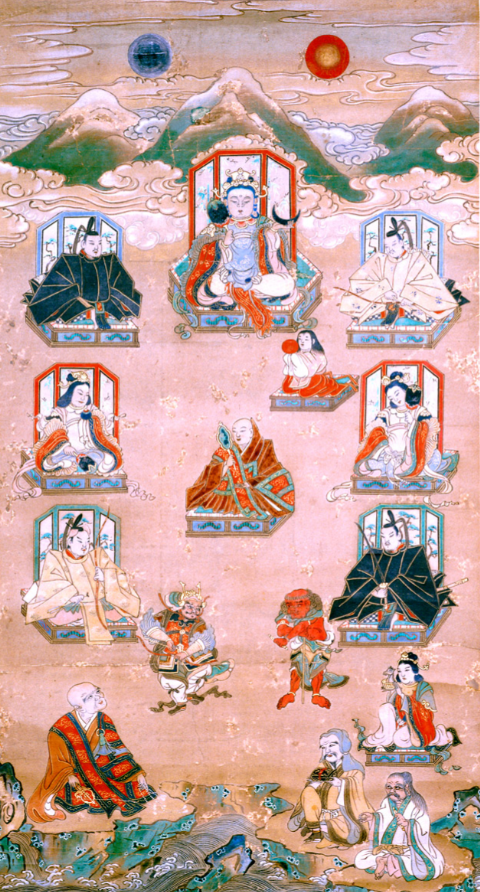
This mandala depicts Mount Hakusan, one of Japan’s most revered sacred mountains, and reflects the syncretic tradition of Shinto and Buddhism.
At the top are the sun and moon, with Hakusan’s three peaks below. It also depicts the deities associated with each of the three peaks, as well as Taichō, the Buddhist monk traditionally credited with opening Mount Hakusan as a sacred mountain.
However, in the latter half of the nineteenth century, Japan underwent the Meiji Restoration, a period of modernization during which the nation sought to establish a centralized modern state modeled on Western countries.
The Japanese government regarded traditional forms of religious belief as overly ambiguous and therefore premodern, particularly in contrast to religions such as Christianity, with their clearly defined doctrines. Consequently, it enacted policies to separate Shinto shrines, where deities (kami) are worshipped, from Buddhist temples, where Buddhas are enshrined. Shugendō, regarded as excessively magical and superstitious, was officially abolished.
During this period, the radical anti-Buddhist movement known as Haibutsu Kishaku (“abolish Buddhism and destroy Śākyamuni”) also spread throughout the country. Many sacred mountains were stripped of their Buddhist elements. Even on Mount Fuji, Japan’s highest peak, the Dainichi Hall at the summit was removed and replaced by the Okumiya Shrine of Sengen Taisha. The summit was thus transformed into the distinctly Shinto appearance that visitors see today.
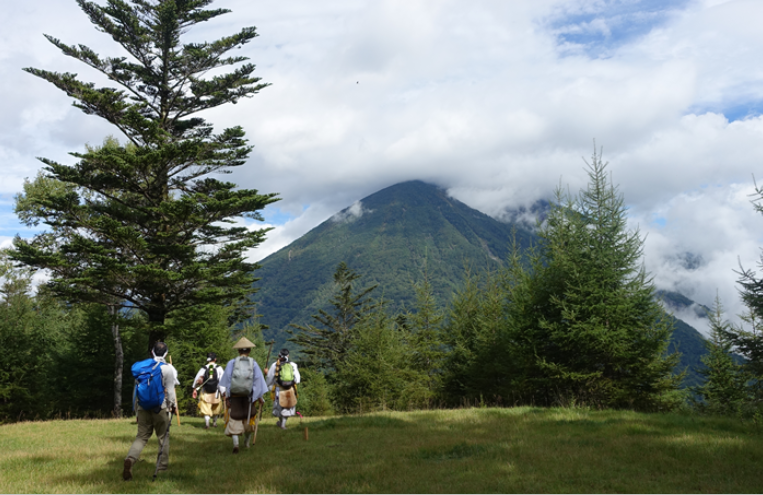
Although Shugendō was once abolished, it was later revived, and its traditions continue to this day. In memory of Enkū, I participated in the autumn ascetic training of the Nikko Shugendō tradition. The mountain in the center is Mt. Nantai, formerly known as Mt. Futarasan.
Despite the turbulent currents of history, the Japanese people’s reverence and affection for mountains have remained unchanged.
While embracing the ideas and techniques of Western alpinism, Japanese people continue to maintain deep relationships with mountains through mountaineering and many other activities.
Japan is said to have one of the world’s largest communities of mountain enthusiasts.
Behind this lies a long and continuous history of intimate engagement with mountains, extending back far beyond the birth of modern alpinism in the nineteenth century.
One figure who embodies this profound relationship between the Japanese people and mountains is Enkū (1632–1695).
Enkū, who lived during the early Edo period, was an outstanding mountain ascetic. He made solitary ascents of several 3,000-meter-class peaks in the Hida Mountains and even explored Hokkaido at a time when these regions had not yet been geographically understood.
As a young man, Enkū left the temple where he had been ordained. Until he formally received Buddhist precepts at the age of nearly fifty at Onjō-ji Temple—the head temple of the Jimon branch of Tendai Buddhism, unique in Japan for integrating exoteric Buddhism, esoteric Buddhism, and Shugendō—he traveled throughout the country as “a man belonging to nothing”: neither monk nor mountain ascetic. In this sense, he was an extraordinarily free spirit for his age, devoting himself to rigorous mountain training.
During his lifetime, Enkū is said to have created as many as 120,000 Buddhist and Shinto images, an almost superhuman achievement. Art historians have highly praised his works, noting that, while Europe was experiencing the Baroque era, Enkū had already achieved forms of expression remarkable for their abstraction and spirituality—qualities that resonate strongly with modern sculpture.
However, as a consequence of the Meiji government’s efforts to modernize religion, Enkū—whose activities were deeply rooted in the syncretic traditions of Shinto and Buddhism and closely connected with Shugendō—was largely forgotten.
It was not until the 1950s that Enkū began to attract renewed attention, primarily through the rediscovery of his religious sculptures, now commonly known as Enkū-butsu. These images were reappraised as precursors of modern sculpture, triggering a nationwide “Enkū boom.” Enkū exhibitions have since been held almost every year, nearly 5,400 surviving statues have been identified, and scholarly research has progressed significantly.
In contrast, Enkū’s achievements in the mountains — well known during the Edo period — have received remarkably little attention.
I was born in the Mino region of Gifu Prefecture, the same region as Enkū. Over the years, I have visited nearly one thousand mountains throughout Japan. I was astonished to discover that traces of Enkū seemed to appear ahead of me wherever I went. Fascinated by this mysterious presence, I have spent the past five years following his footsteps and tracing the course of his life.
In particular, regarding his mountain ascetic practices—which had previously received little scholarly attention — I conducted extensive preliminary research and attempted, whenever possible, to follow Enkū’s journeys in chronological order, during the same seasons, and along the same routes. By retracing his footsteps and experiencing the hardships of his training firsthand, I gradually began to see the outlines of Enkū’s extraordinary mountain adventures, in which he repeatedly risked his life.
Through this process, I also came to realize that Enkū, who had been overwhelmed by the destructive power of nature in his childhood, deepened his faith through mountain asceticism and eventually transcended those experiences. This spiritual journey, I believe, found expression in the powerful forms of his sculptures.In the episodes to come, I invite you to join me in following “The Adventures of Enkū.”
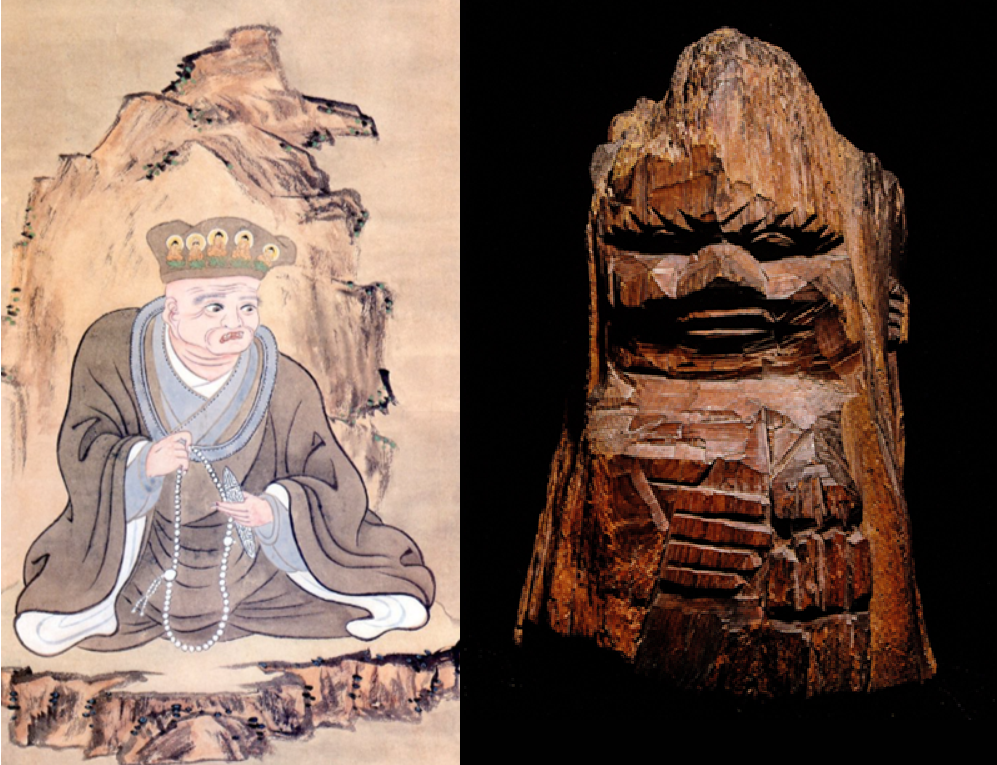
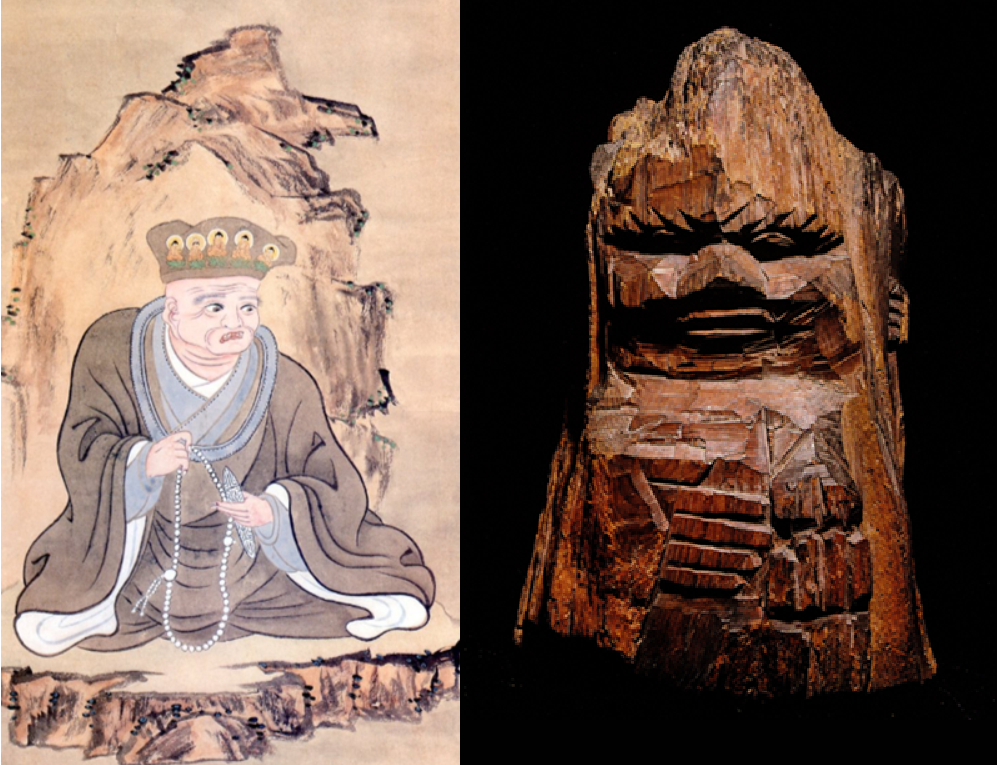
(Right): Statue of a Guardian Deity, Ongakuji Temple Collection. Photo by Masashige Hasegawa
