
Tokyo’s Ultra-Low Mountains
Rediscovering the City Through Its Hidden Mountains
By Kazuhiko Miwa
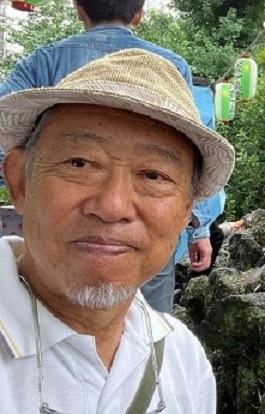
Kazuhiko Miwa,
A writer, former high school teacher, and long-distance journey runner. He is a member of the Tokyo Metropolitan University Alpine Club, founder and organizer of Miwa-juku, a science seminar series for adults, and a coordinator of the Horizon Conference, a long-running Japanese forum for explorers and travelers. In recent years, he has devoted much of his time to researching komainu—traditional guardian lion-dog statues found at shrines and temples throughout Japan. He has authored several books on travel, running, languages, and environmental issues.
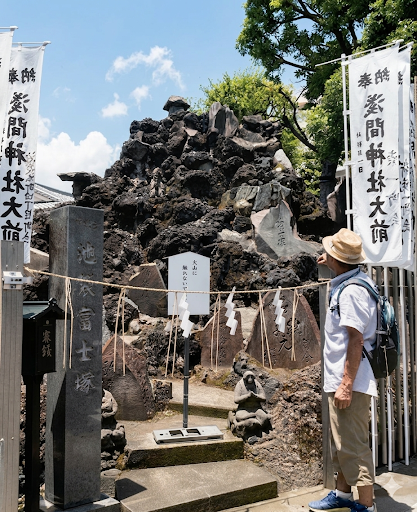
About This Series
Tokyo’s Ultra-Low Mountains is based on articles originally published on the Japanese “Mountain Day” website ahead of the 2024 Japan Mountain Day National Convention in Tokyo. The series has been re-edited and expanded for English readers.
Prologue: The Hidden Landscape Beneath Tokyo
Tokyo is famous for its skyscrapers, bustling streets, and modern cityscape. Yet hidden among them are dozens of tiny hills and historic “ultra-low mountains,” each with its own story. This series invites readers to rediscover Tokyo from an unexpected perspective—one mountain at a time.
Tokyo is home to many high mountains, including Mt. Kumotori(2017m)in western Tokyo.
But the “TOKYO” discussed here is something different — the densely built urban landscape most people imagine when they think of the city.
Geographically, this urban Tokyo is built across two contrasting terrains:
the Musashino Plateau, which rises about 20 to 80 meters above sea level, and the low-lying downtown areas that are close to sea level.
On standard 1:25,000 topographic maps, the countless buildings hide the contour lines.
But in recent years, shaded-relief maps and topographic visualization maps have become widely available, and with these in hand I began searching for the “mountains” hidden within TOKYO.
Even on official maps, places such as Asukayama, Atagoyama, and Daikanyama still carry the word yama — “mountain” or “hill” — in their names.
As I explored these places, I realized that many of them stand along cliffs marking the edge between plateau and lowland, or on steep slopes carved by rivers such as the Kanda River cutting into the plateau.
During the COVID-19 pandemic, people avoided crowds, and older residents in particular were encouraged to walk in quiet, less populated places.
During that period, I began what I called my “100 Ultra-Low Mountains of Tokyo” project.So far I have climbed only about seventy of them, but in this series I would like to introduce some of my favorite ultra-low mountains hidden within Tokyo.
Tokyo’s Ultra-Low Mountains
Episode 1
Ōuchi-yama — The Hill of Edo Castle
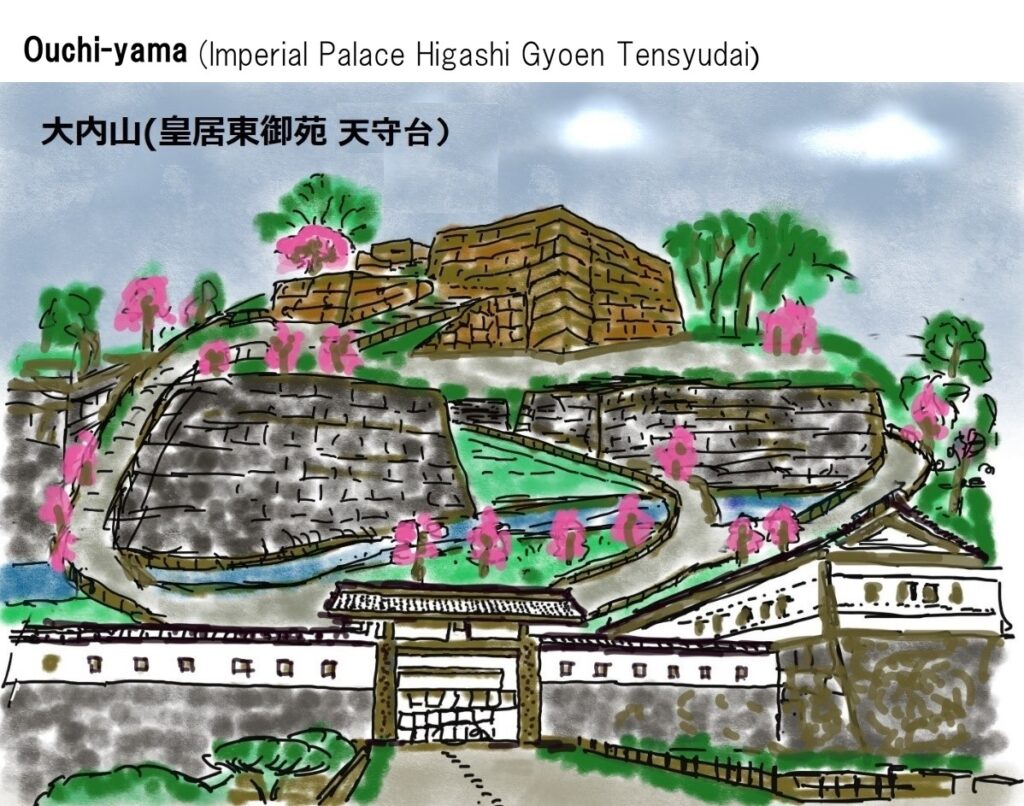
Cherry blossom season had interrupted my “ultra-low mountain climbing,” but after some time away I finally headed out again for a combination of “ultra-low mountain climbing and cherry blossom viewing.”
The Imperial Palace — formerly Edo Castle — stands on surprisingly high ground.
Looking at old maps, the area where Tokyo Station now stands was once reclaimed land along the sea.
The massive stone walls across the moat were built over ancient sea cliffs and reinforced with huge stones transported from the Izu Peninsula.
It is said that when Tokugawa Ieyasu first came to Edo, people joked:
“Edo has neither beautiful women nor stones.”
Edo Castle was originally built as a mountain fortress on the eastern edge of the Musashino Plateau. After Tokugawa Ieyasu entered Edo, however, it was transformed into a powerful stone castle using rocks transported from distant regions.
The area in front of today’s Imperial Palace was once the Hibiya inlet, making it convenient for ships carrying enormous stones.
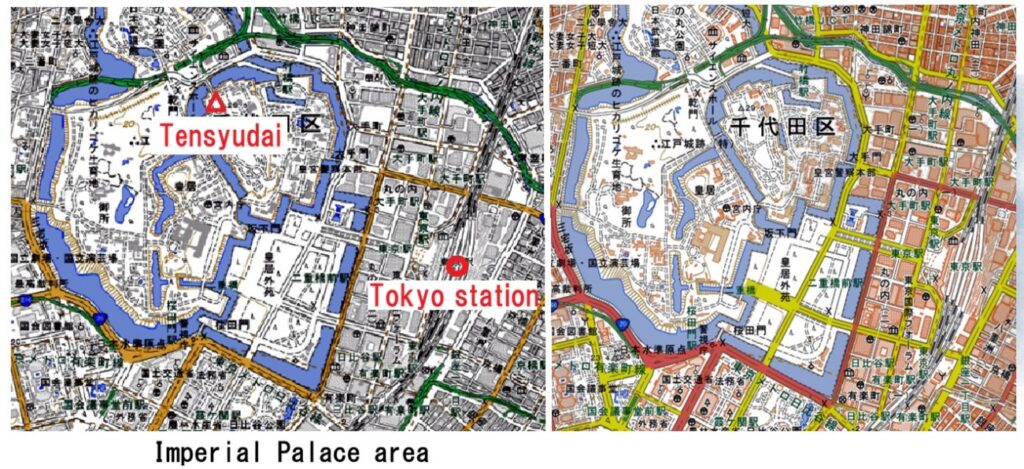
The elevation of Otemachi is only about 3 meters above sea level, while the top of the castle keep foundation rises to 29.5 meters.
Viewed from the moat below, it truly looks like a mountain.The entire Imperial Palace area is known as Ouchi-yama.
Of course, the Emperor’s residence itself is not open to the public, but the East Gardens — where the Edo Castle keep once stood — can be visited freely.
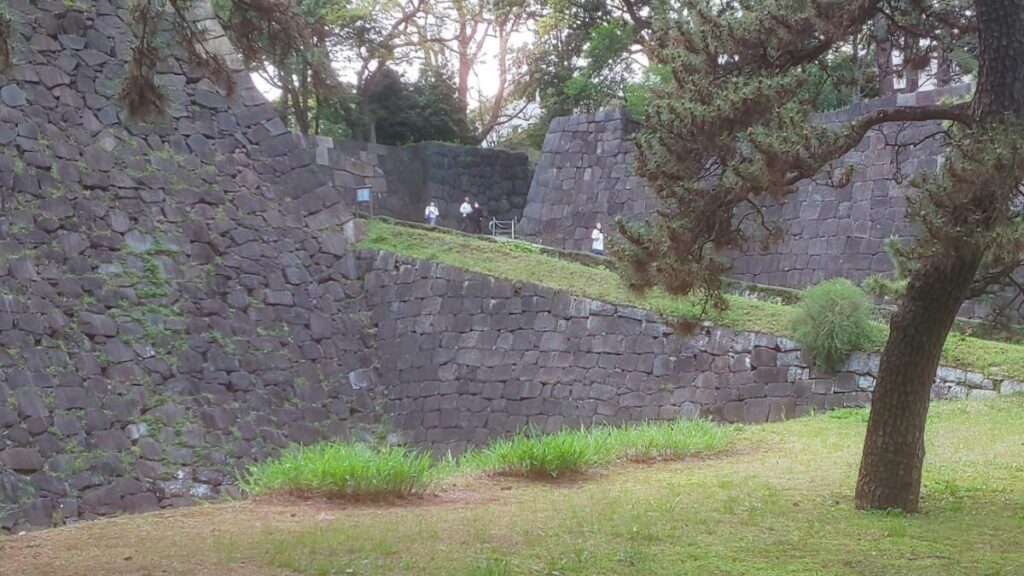
In March 2023, as the COVID pandemic began to subside, huge crowds gathered near the Otemon Gate for the famous cherry blossom walk through the Inui Street.
Yet once inside the East Gardens, there were surprisingly few people on Shiomi-zaka Slope leading up toward the castle keep foundation.
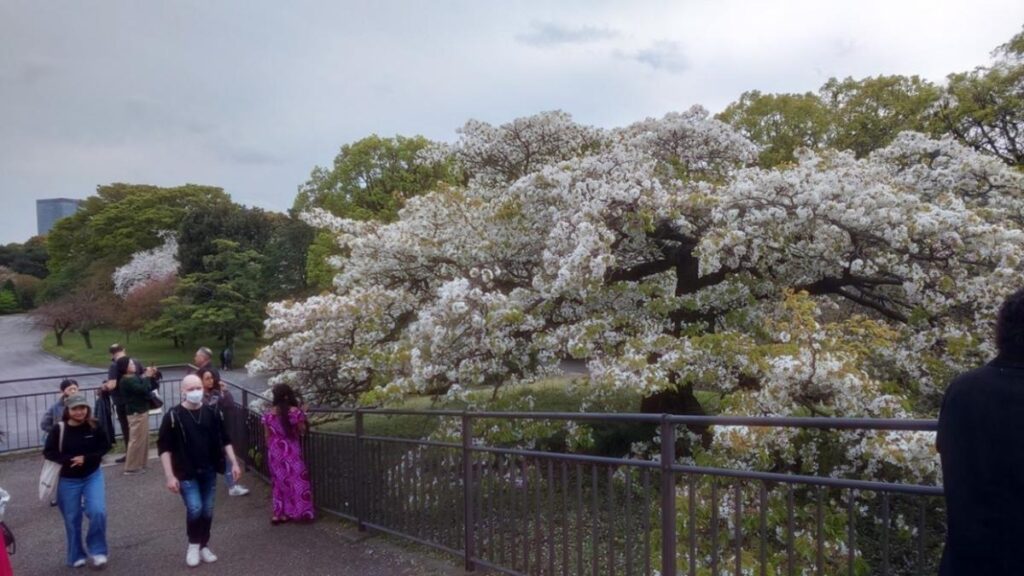
Most of the Somei Yoshino cherry trees had already lost their blossoms, but the mountain cherry trees were still in magnificent full bloom.Large clusters of rhododendrons were also flourishing, and even without joining the crowds along Inui Street, it was possible to enjoy a wonderful hanami — traditional Japanese cherry blossom viewing — experience.
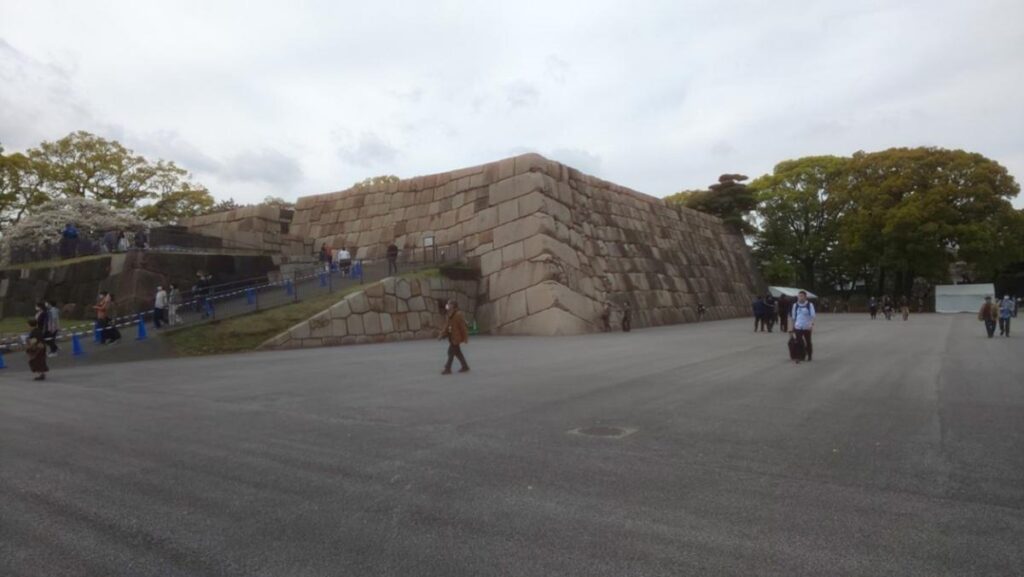
Today, only the enormous stone foundation of the castle keep remains.
Originally, a magnificent keep tower 51 meters high stood here, but after it was destroyed in the Great Fire of Meireki in 1657, it was never rebuilt.
Perhaps by then the country had already entered a peaceful age, and there was no longer any need for the Tokugawa shogunate to display its authority through such an imposing structure.
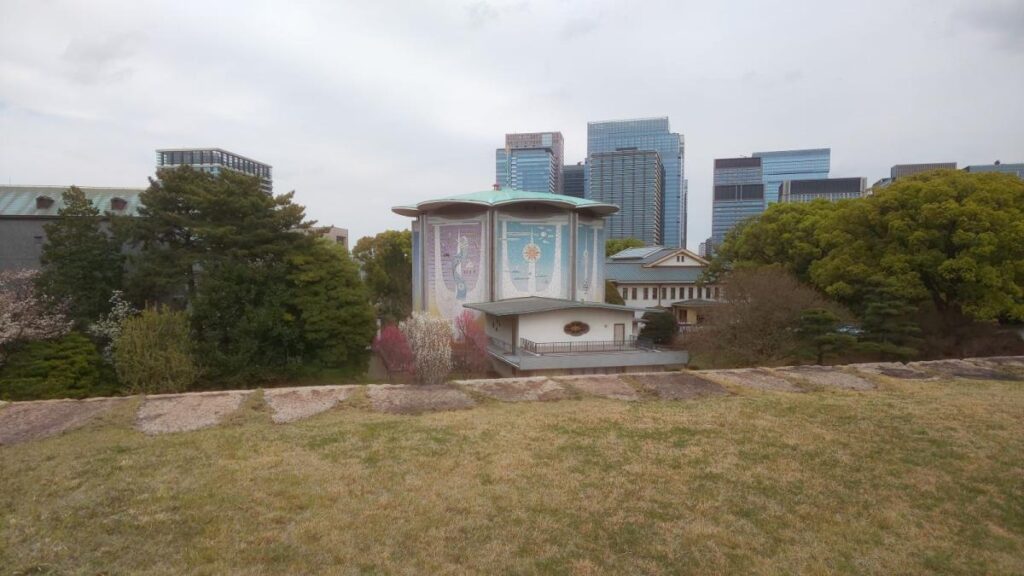
From the top of the foundation, one can see the Museum of the Imperial Collections and, beyond it, the skyscrapers that now form the modern gateway to Tokyo.
From the top of the former castle tower, people may once have looked across Edo Bay toward the mountains of the Boso Peninsula (present-day Chiba Prefecture).
In recent years, there was even a movement advocating reconstruction of the Edo Castle keep on this very foundation.
However, the plan was never completed in time for the 2020 Tokyo Olympics.
Even without the tower, the view is more than enough.
Personally, I feel that no taller structure is needed within the peaceful landscape of the Imperial Palace gardens.
On the way back, I descended through Kitahanebashi-mon Gate, crossed the moat into Kitanomaru Garden, passed the Nippon Budokan, and exited through Tayasu Gate toward Kudanshita Station.
From Tokyo Station, I had walked for nearly two hours.
My pedometer showed more than 10,000 steps.Just how enormous Edo Castle must once have been.
