
Hello everyone,
I am Yasuhiko Takano, Director of the Toyama Prefectural Tateyama Museum.In the previous installment, we explored how Tateyama was revered from afar as a sacred mountain during the Nara period. This time, we turn to the Heian period to see how Tateyama’s religious character further evolved.
The Emergence of Oyama Deity
During the Heian period, the deity of Tateyama was gradually incorporated into the state religious system as a guardian of the nation. In the historical chronicle Nihon Sandai Jitsuroku, an entry dated 863 (Jōgan 5) records that Oyama Deity was granted the court rank of Junior Fifth Rank, marking the first appearance of Tateyama’s god in official documents.Later, the Engishiki—completed in 927—lists seven shrines in Niikawa District, including Oyama Shrine. These records indicate that, by the Heian period, the deity of Tateyama had been formally recognized and worshipped as a state deity.
However, it remains unclear whether the Oyama Shrine of that era stood in the same location as the present shrine.
A Ritual Staff Finial Discovered on Mt. Dainichi
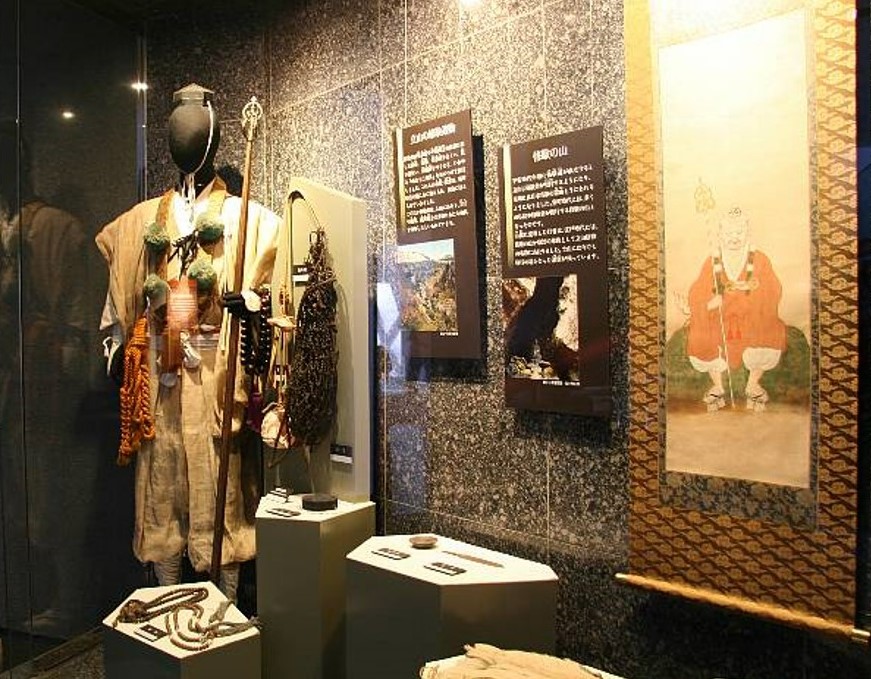
The Heian period is also thought to be the time when Buddhist practices became closely associated with Tateyama, transforming it into a site of ascetic training.
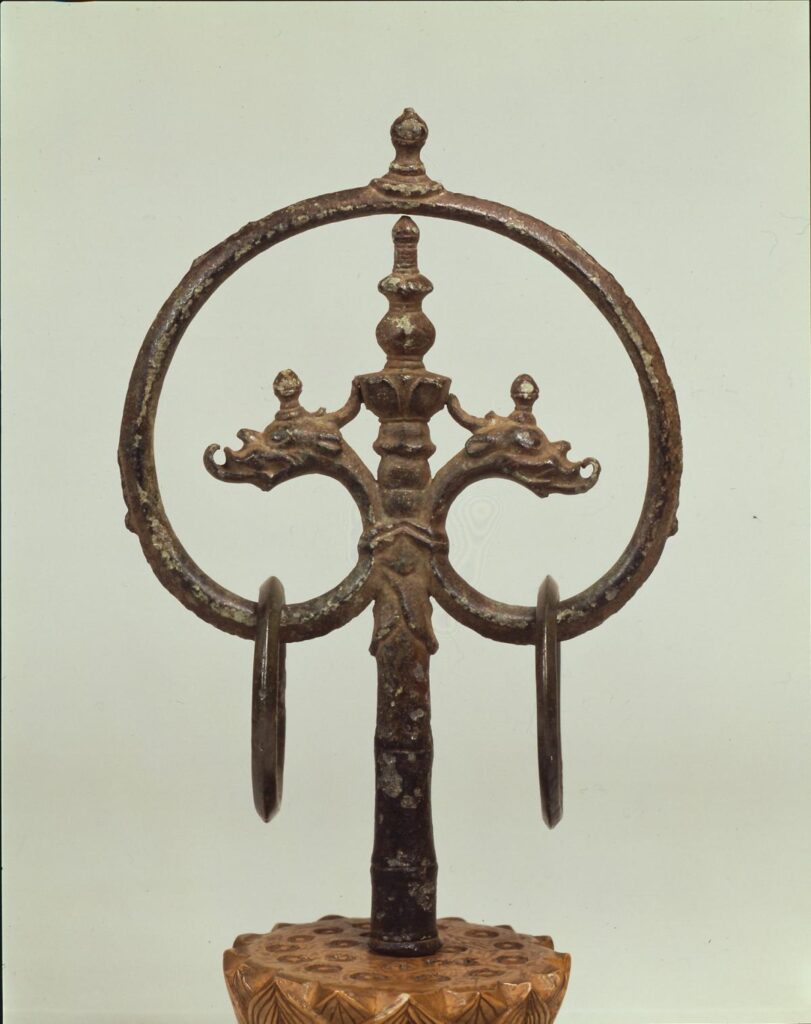
In July 1893, a ritual staff finial (shakujōtō) dating to the late Heian period was discovered on Mt. Dainichi. The artifact was found by Isotarō Kawai during a mountain expedition undertaken in search of hot springs, together with three guides. A shakujō is a ritual staff used by mountain ascetics who practiced in remote and rugged terrain. It functioned as a walking aid and as a tool to make sound to ward off wild animals, but it also held important religious significance.The metal fitting attached to the top of the staff is known as a shakujōtō. The example discovered on Mt. Dainichi—decorated with twin dragons—was designated an Important Cultural Property of Japan in 1963. Its distinctive features include a slightly swollen ring and dragon heads crowned with sacred jewels, connected by softly curling vine-like forms.

Ritual Objects Discovered on Mt. Tsurugi
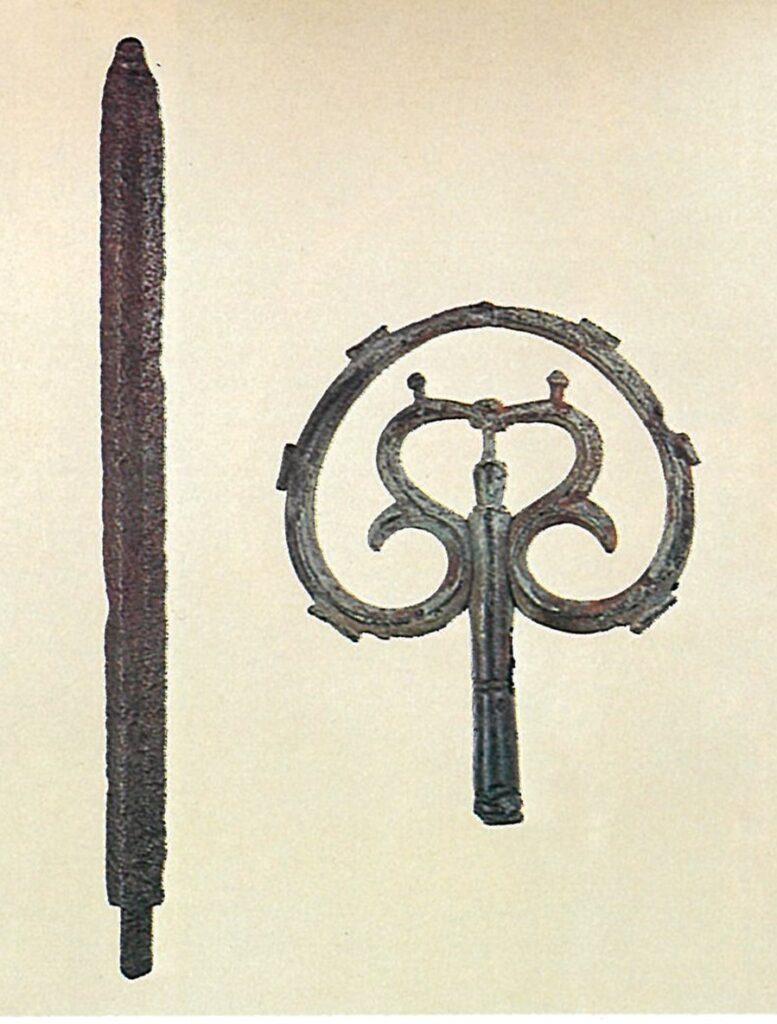
In July 1907, Yoshitarō Shibasaki of the Army General Staff Office’s Land Survey Department reached the summit of Mt. Tsurugi, which was then believed to be unclimbed. During this ascent, he discovered another ritual staff finial along with an iron sword.
This episode later became widely known through Jirō Nitta’s novel Tsurugidake: Ten no Ki and its film adaptation directed by Daisaku Kimura.
The ritual staff finial with iron sword found on Mt. Tsurugi is believed to date to the early Heian period and was designated an Important Cultural Property in 1959. The finial features a fan-shaped ring with fern-scroll motifs curling inward at the base, giving it a powerful and robust impression. In 1982, the artifacts were donated to Toyama Prefecture through the generosity of the Shibasaki family.The ritual staff finials discovered on Mt. Dainichi and Mt. Tsurugi are among the most important archaeological remains for understanding the development of sacred mountain worship in Japan.

What Do These Heian-Period Ritual Objects Tell Us?
The presence of these ritual staff finials suggests that Mt. Dainichi and Mt. Tsurugi lay within the sphere of activity of mountain ascetics. If large-scale rituals had been conducted on the summits, other ritual-related artifacts would likely have been found. However, only the ritual staff finials—and in one case, an iron sword—have been discovered.
Why might this be?
The shakujō was not only a ritual implement but also a tool used to establish a sacred boundary (kekkai)—a division between the sacred and the profane. Mountains, in themselves, were not automatically regarded as suitable sites for Buddhist practice. They became places of ascetic training only after being ritually sanctified by mountain practitioners.
From this perspective, the ritual staff finials and iron sword discovered on Mt. Dainichi and Mt. Tsurugi were likely offerings placed to sanctify these peaks as sacred mountains where deities and buddhas could descend.
In the next installment, we will introduce the Legend of the Founding of Tateyama, a key narrative in the history of Tateyama faith. I hope you will continue to follow this series.
Written by Yasuhiko Takano
Director, Toyama Prefectural Tateyama Museum
Editorial Note
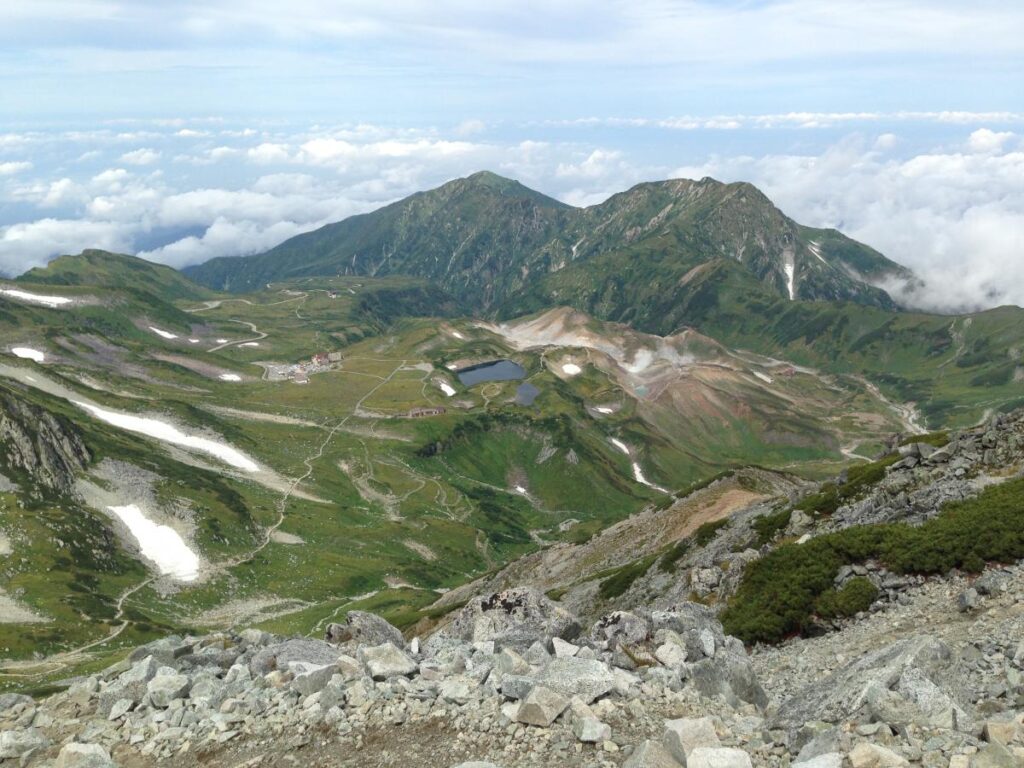
At the Toyama Prefectural Tateyama Museum, the actual ritual staff finials discovered on Mt. Dainichi and Mt. Tsurugi—both designated Important Cultural Properties—are on permanent display. These rare artifacts, dating back approximately 1,300 years, vividly convey the origins of mountain worship in Tateyama.
#https://www.yamanohi.net
#Toyama Prefectural Tateyama Museum
#Mountain Faith
# Mt Dainichi
