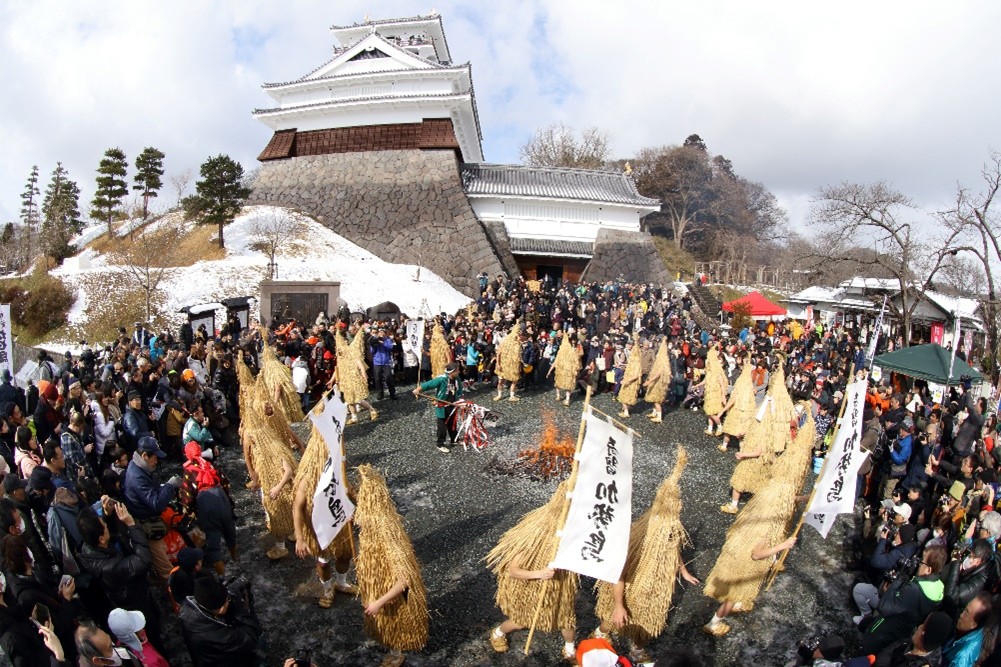
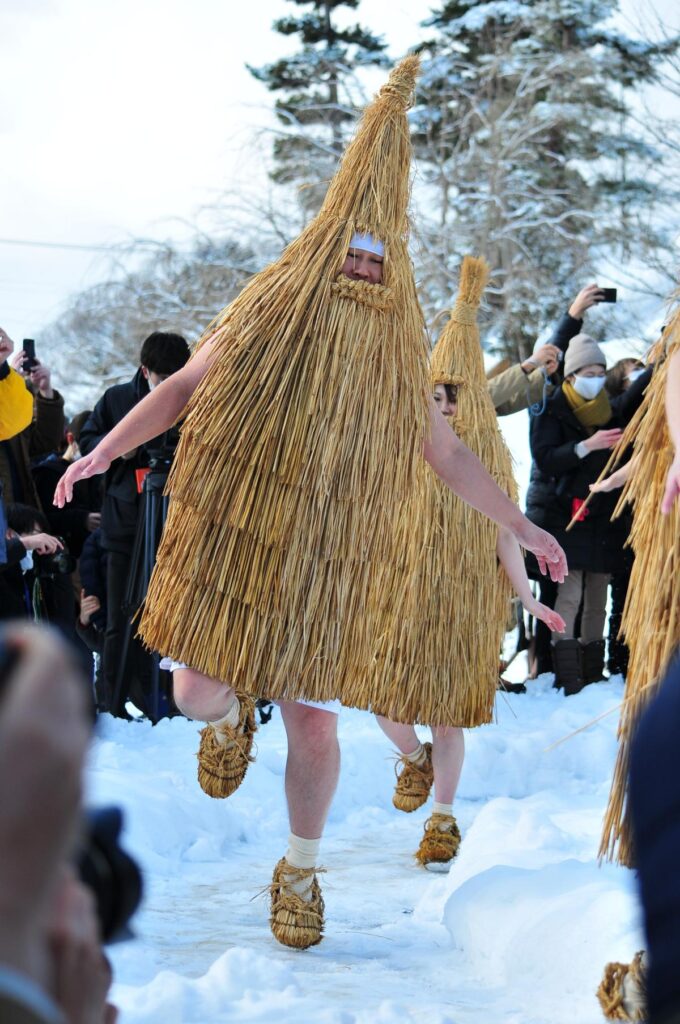
Every February 11, the quiet castle town of Kaminoyama transforms into a scene unlike anywhere else in Japan. Men dressed in straw cloaks walk through the streets shouting “Kakkakkaa!” as residents splash them with buckets of water.
This is Kasedori, one of Japan’s most unusual winter festivals.
On a freezing winter morning in northern Japan, a strange figure appears in the streets.
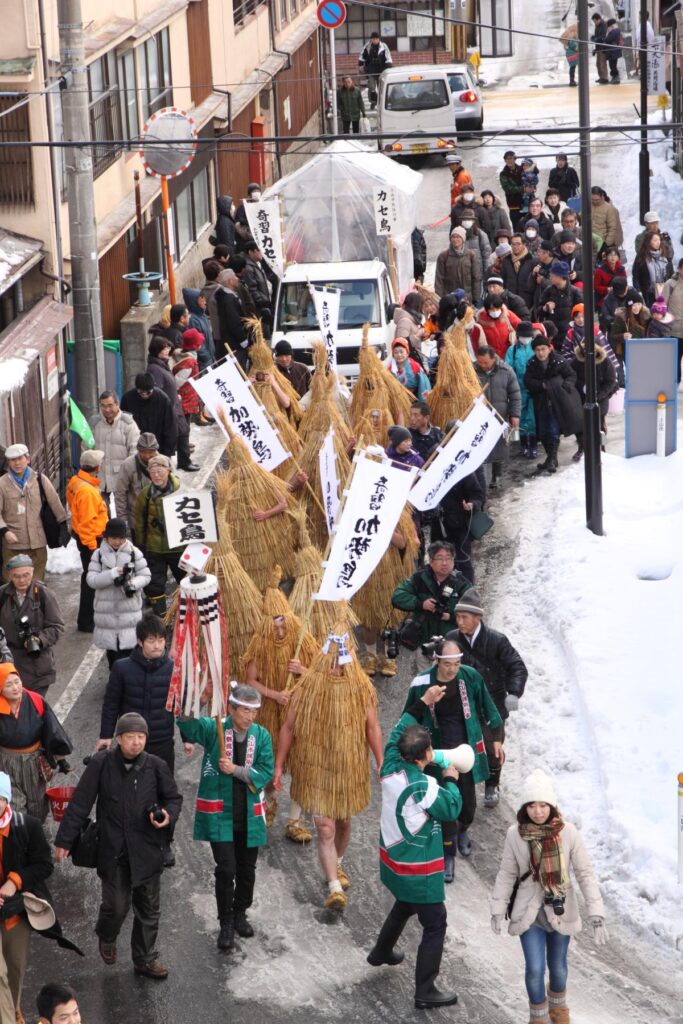
Covered entirely in straw and shouting “Kakkakkaa!”, the figure walks through the old castle town while people throw buckets of water over him.
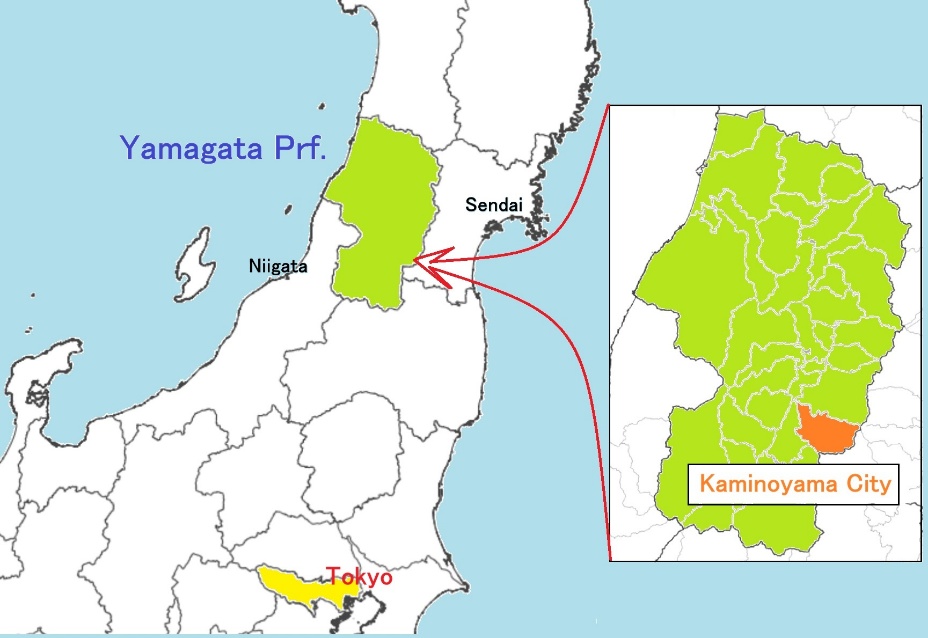
This dramatic scene is part of Kasedori, a traditional winter festival held every year on February 11 in Kaminoyama City, Yamagata Prefecture.Despite the cold, the festival is filled with laughter and excitement. For the people of Kaminoyama, it is a joyful ritual that celebrates good fortune, prosperity, and protection for the year ahead.
A “Bird” That Brings Good Fortune
The name Kasedori is often interpreted as “the bird that brings prosperity.”
In earlier times, people believed that during the New Year season a divine spirit would visit villages from distant lands, bringing blessings for the coming year.
The Kasedori represents this visiting spirit.
As the straw-covered figure walks through the town, residents welcome it and pray for
successful harvests
thriving businesses
family happiness
and safety from disasters.
Three young men from Takano Village were once allowed to perform the Kasedori ritual before the lord of Kaminoyama Castle during the Edo period.
Why People Throw Water
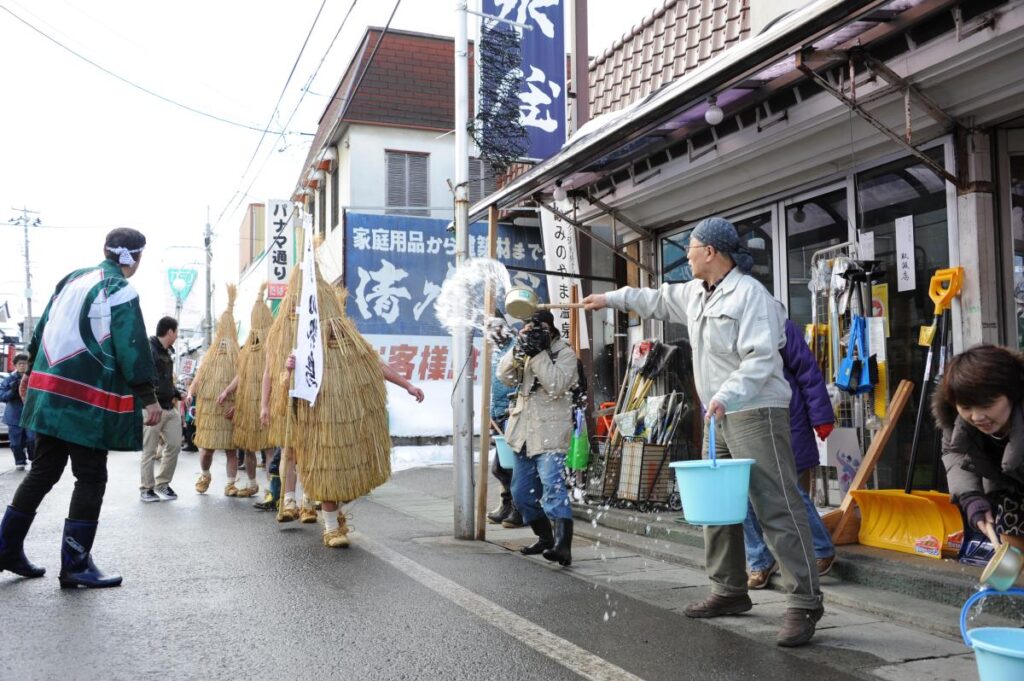
One of the most unforgettable sights of the festival is when residents pour water over the Kasedori.
The water is known as “celebration water.”
In traditional belief, clean water symbolizes life, purity, and abundance, so splashing water is a way of wishing prosperity for the year ahead.
There is another meaning as well.Kaminoyama experienced devastating fires in the past, and people once believed that a mysterious “fire-eating bird” in the sky spread flames during those disasters. Because the Kasedori resembles a bird, throwing water on it also came to symbolize prayers for protection from fire.
A Kasedori performer walks through the castle town streets shouting “Kakkakkaa!” as part of the winter ritual.
A Costume Made from Straw
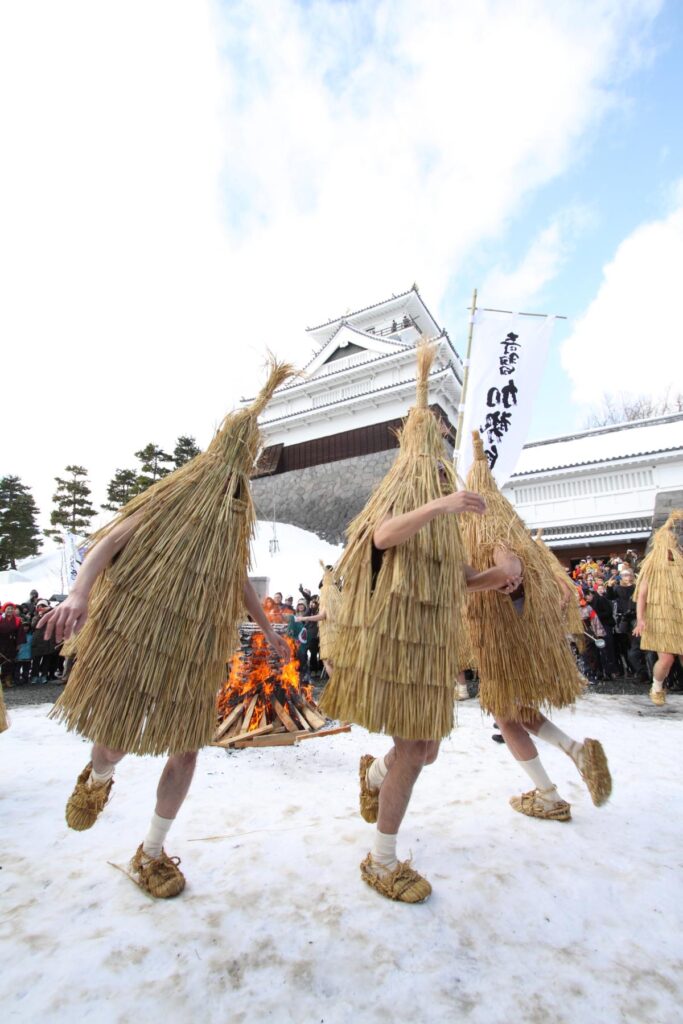
The performer wears a large straw cloak called a Kendai, woven entirely from rice straw.
It covers the body from head to toe and can weigh up to 10 kilograms when soaked with water.
Making this costume is itself a rare traditional skill. Only a few members of the local preservation society still know how to weave the Kendai using traditional tools.The straw sandals worn by the performers are also handmade by local residents, reflecting the deep community involvement that keeps the festival alive.
Residents pour “celebration water” over the Kasedori, a traditional act believed to bring prosperity and protect the town from fire.
Good Luck from a Strand of Straw
Visitors can participate in several small traditions during the festival.
When the Kasedori arrives, people may wrap a new towel or cloth around the straw costume while making wishes for the coming year.
Strands of straw that fall from the costume are considered lucky charms, believed to carry the blessing of the visiting spirit.
A local saying even suggests that tying a girl’s hair with Kasedori straw will help her grow into a beautiful woman with long black hair.
A Tradition Revived
Like many traditional festivals in Japan, Kasedori once disappeared.
After the political changes of the late nineteenth century, the event was abolished and eventually faded away.
But in 1959, local residents revived the festival, determined to preserve their heritage. Today the Kasedori Preservation Society continues to pass the tradition to younger generations.
The Kendai, a large straw cloak worn by the Kasedori performer, is carefully woven from rice straw by local craftsmen.
Experience Kasedori
Every year on February 11, the streets of Kaminoyama once again echo with the cry “Kakkakkaa!” As the straw-clad figures move through the town and water splashes into the winter air, visitors can experience a living tradition that connects the present with centuries of local history. Kasedori is not just a festival. It is a celebration of community, resilience, and hope for the year ahead.
Acknowledgment
This article was prepared based on materials provided by the Kaminoyama Folk Festival Kasedori Preservation Society.All photographs are courtesy of the Kaminoyama Tourism and Products Association.
Hello everyone, I am Yasuhiko Takano, Director of the Toyama Prefectural Tateyama Museum.
In the previous installment, I introduced how Jigokudani (Hell Valley) on Mount Tateyama came to be revered as a place where hell described in Buddhist teachings was believed to exist in reality. I also discussed Heian-period Buddhist tales in which women who had fallen into hell were saved through metsuza kuyō—memorial offerings based on the Lotus Sutra—and were reborn in Trāyastriṃśa Heaven.
In this installment, I will focus on the relationship between Tateyama and Taishakuten, the deity believed to reside in Trāyastriṃśa Heaven, and examine his role within Tateyama faith.
According to Volume 14 of the Konjaku Monogatari-shū, Tateyama is home not only to hell but also to a great peak known as Taishaku no Take, the mountain where Taishakuten is said to reside. There, Taishakuten gathers with officials of the netherworld to observe and judge the good and evil deeds of human beings, determining whether they are to be cast into hell.
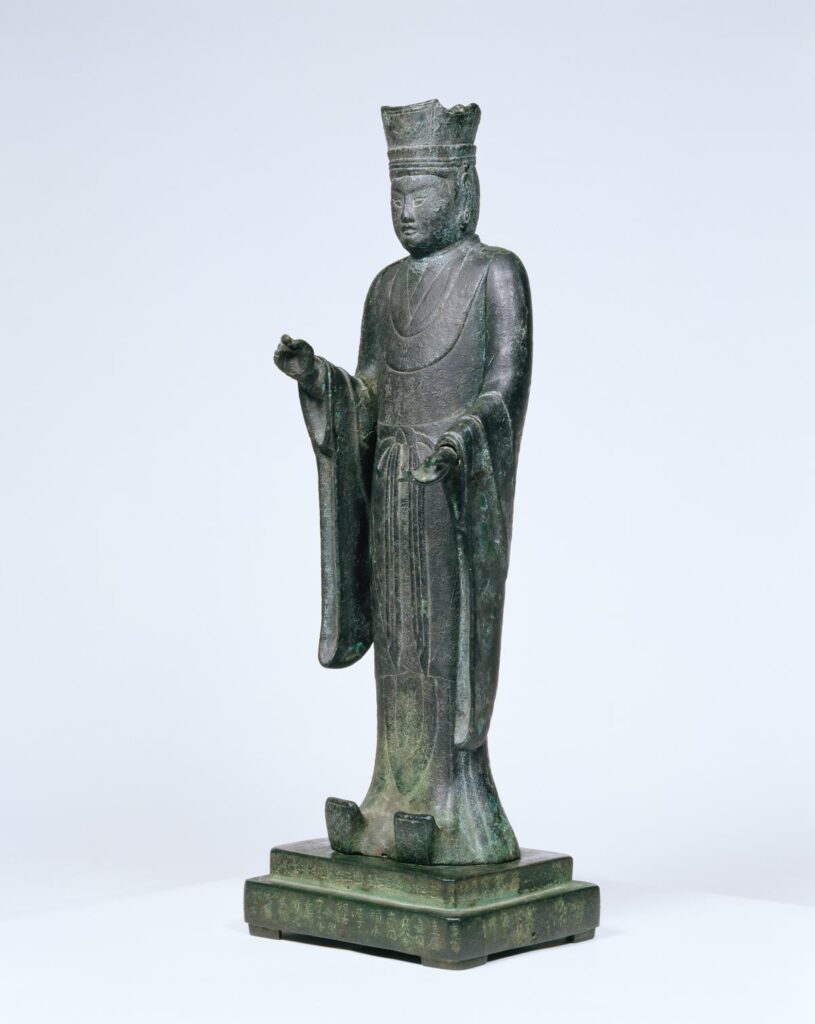
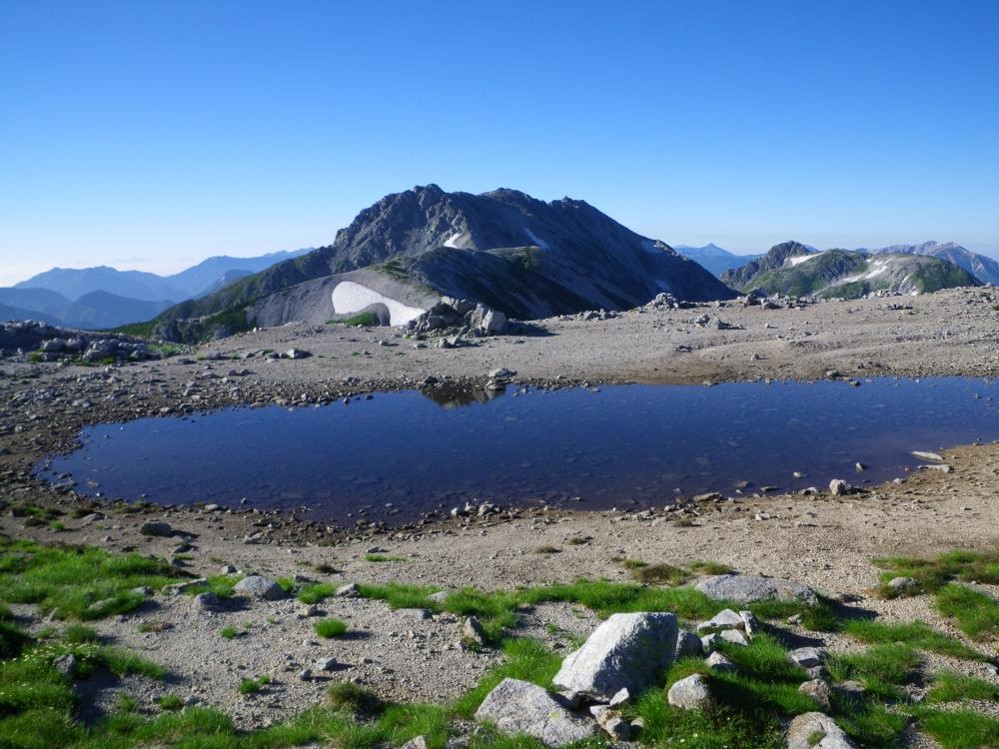
Taishakuten is one of the heavenly beings (tenbu) who protect Buddhism and originates from Indra, the ancient Indian god of war. He is sometimes depicted holding a brush and a scroll, symbolizing his role as a recorder and judge of human actions. In this respect, Taishakuten functioned much like King Enma, serving as a judge of hell in Buddhist belief.Edo-period (1615-1868) sources such as the Wakan Sansai Zue and the Tateyama Mandala identify Mt. Bessan, one of Tateyama’s three sacred peaks, by the alternate name Mount Taishaku. During this period, Taishakuten was enshrined on Mt. Bessan. Near its summit lies Suzuriga-ike (Inkstone Pond), believed to be the place where Taishakuten used its water as ink to record and judge the deeds of sentient beings.
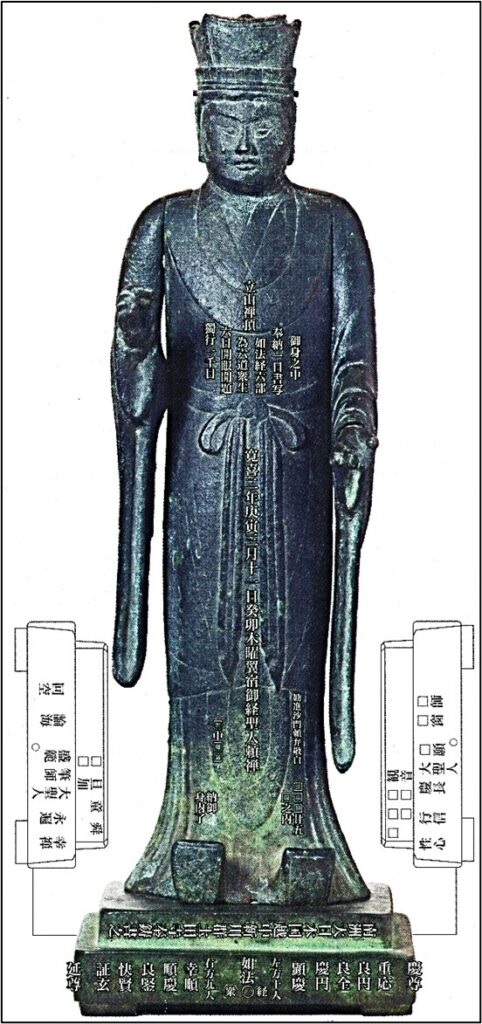
Standing bronze statue of Taishakuten (National Important Cultural Property of Japan, Kamakura period; collection of the Toyama Prefectural Tateyama Museum)
Suzuriga-ike (Inkstone Pond) near the summit of the southern peak of Mt. Bessan
(2) What the Inscriptions on the Standing Bronze Statue of Taishakuten Reveal
At the Toyama Prefectural Tateyama Museum, we preserve and display a Standing Bronze Statue of Taishakuten, designated a National Important Cultural Property of Japan. In 1991, the statue was exhibited overseas at the British Museum as part of the exhibition Kamakura Sculpture, and it is recognized as one of the representative sculptures of the Kamakura period in Japan.
A distinctive feature of this statue is the presence of inscriptions carved across the chest, legs, and pedestal. These include the phrases “Tateyama Zenjō,” “Kanki 2,” and “Raizen.” The term Zenjō means “mountain summit,” and it is most likely a reference to the summit of Mt. Bessan. Kanki 2corresponds to the year 1230, and Raizen is the name of a monk. From these inscriptions, we can understand that this monk dedicated the statue at the mountain summit.
According to the inscriptions, the purpose of this dedication was to save sentient beings wandering through the Six Realms of rebirth. To this end, the monk copied one fascicle of the Lotus Sutra each day for six consecutive days, following the practice known as nyohōkyō, and placed the completed sutras inside the statue before performing a memorial offering.
In fact, the interior of the statue is hollow and was designed to function as a container for the copied Lotus Sutra.
During the Kamakura period, ascetic practices centered on nyohōkyō—the copying and dedication of the Lotus Sutraaccompanied by rigorous austerities—were carried out on Mt. Bessan at Tateyama. It appears that through these practices, the extinguishing of sins (metsuzai) was believed to be achieved. The judgment of whether such salvation was granted was entrusted to Taishakuten.
Inscriptions on the standing bronze statue of Taishakuten
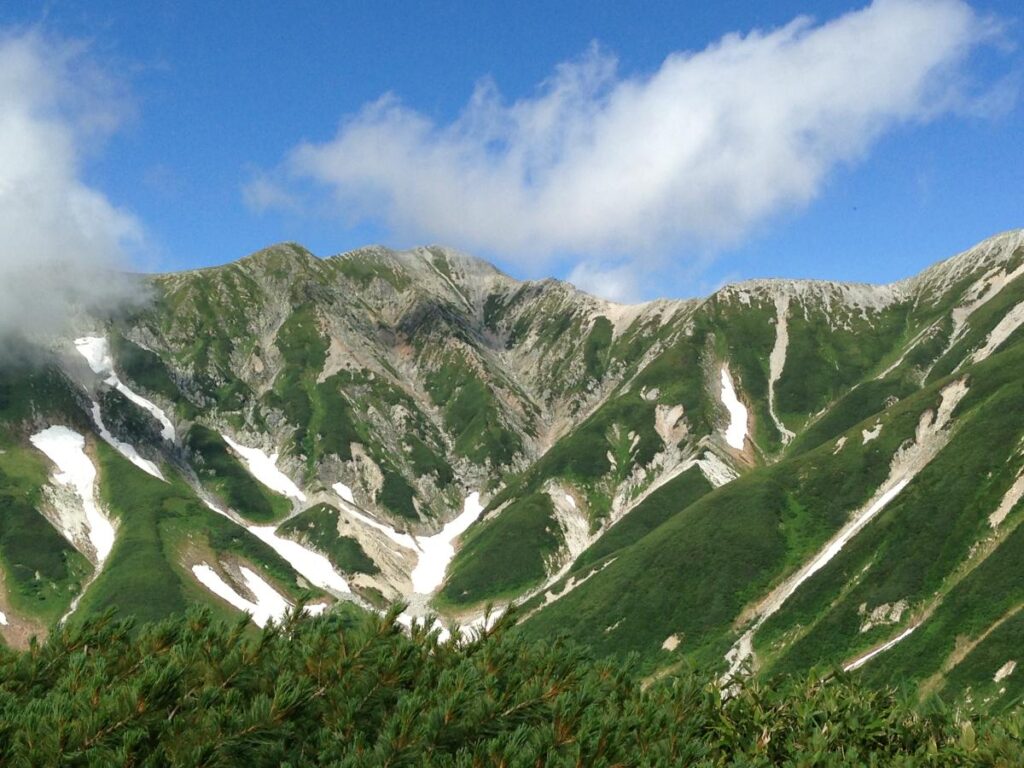
Mt Bessan (elevation 2,880meter)
(3) Enma, King of Hell at Mount Tateyama
At Mount Tateyama during the Kamakura period, it can be confirmed that Taishakuten (Indra) initially fulfilled the role of judge of the underworld. By the late Kamakura period, however, this role appears to have been assumed by Enma, the King of Hell.
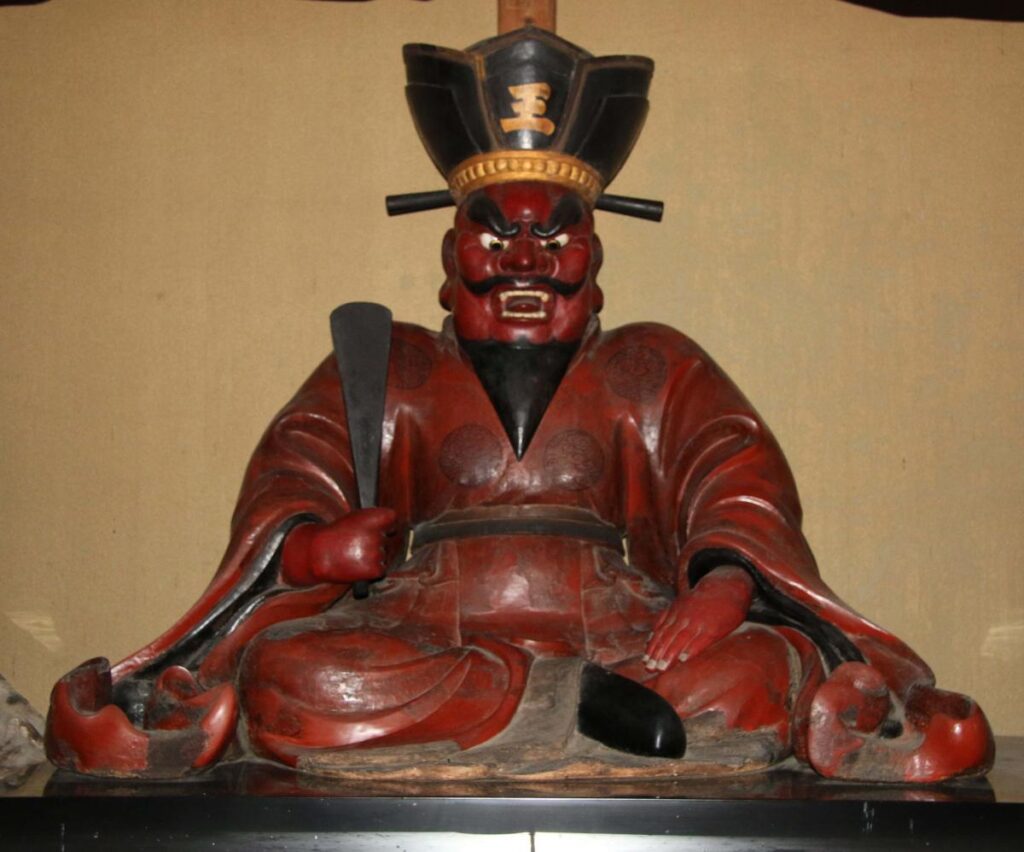
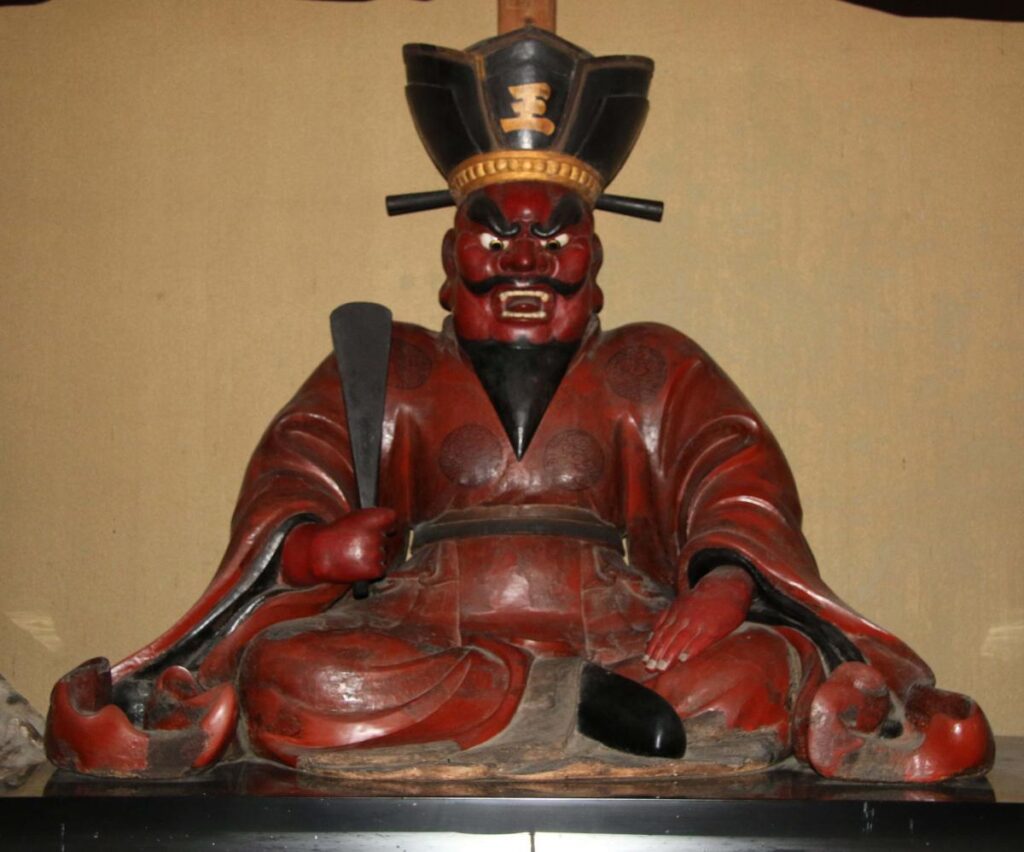
At Ashikuraji Temple in Tateyama stands the Enma Hall (rebuilt in 1928), which houses a seated wooden statue of Enma believed to date from the late Kamakura period. The statue measures over 160 centimeters in height and is relatively large in scale. As Pure Land Buddhism spread during the Kamakura period, it is thought that at Ashikuraji, Enma was enshrined together with Taizanō, Godō Tenrinō, Shimei, and Shiroku in what is known as the “Enma Five-Deity Configuration” (Enma Goson Keishiki). Incidentally, the name “Enma Hall” at Ashikuraji appears in historical documents for the first time in a donation record dated 1466 (Bunshō 1), made by the warrior clan Jinbō.
In addition, an Enma Hall once stood in Jigokudani (Hell Valley) and is depicted in several Tateyama mandalas and mountain pictorial maps from the Edo period. According to tradition, a metal statue of Enma was enshrined there, though the building itself no longer survives.Thus, at Mount Tateyama—known as a mountain of hell—the figure of the “judge of the underworld” came to be firmly established. Beginning with Taishakuten and later giving way to Enma, whose striking appearance and distinctive character captured popular imagination, Enma ultimately became the dominant figure.
Seated Wooden Statue of Enma, King of Hell (Designated Tangible Folk Cultural Property of Toyama Prefecture; Kamakura period; housed in the Enma Hall of Ashikuraji Temple)
The Enma Hall of Ashikuraji
In the next installment, we will introduce the Ashikuraji and Iwakuraji settlements, which served as key centers of Tateyama worship during the Edo period. We hope you will continue to follow this series.
◎ For more on Taishakuten at Mount Tateyama, we recommend the exhibition catalogue Tateyama and Taishakuten, published in conjunction with a special exhibition. For Enma, King of Hell at Mount Tateyama, the exhibition Tateyama × Hell is highly recommended.
For information on how to purchase these publications, please contact the Tateyama Museum.
#https://www.yamanohi.net #Toyama Prefectural Tateyama Museum #Mountain Faith #Mt Tateyama # Taishakuten #Enma, King of Hell
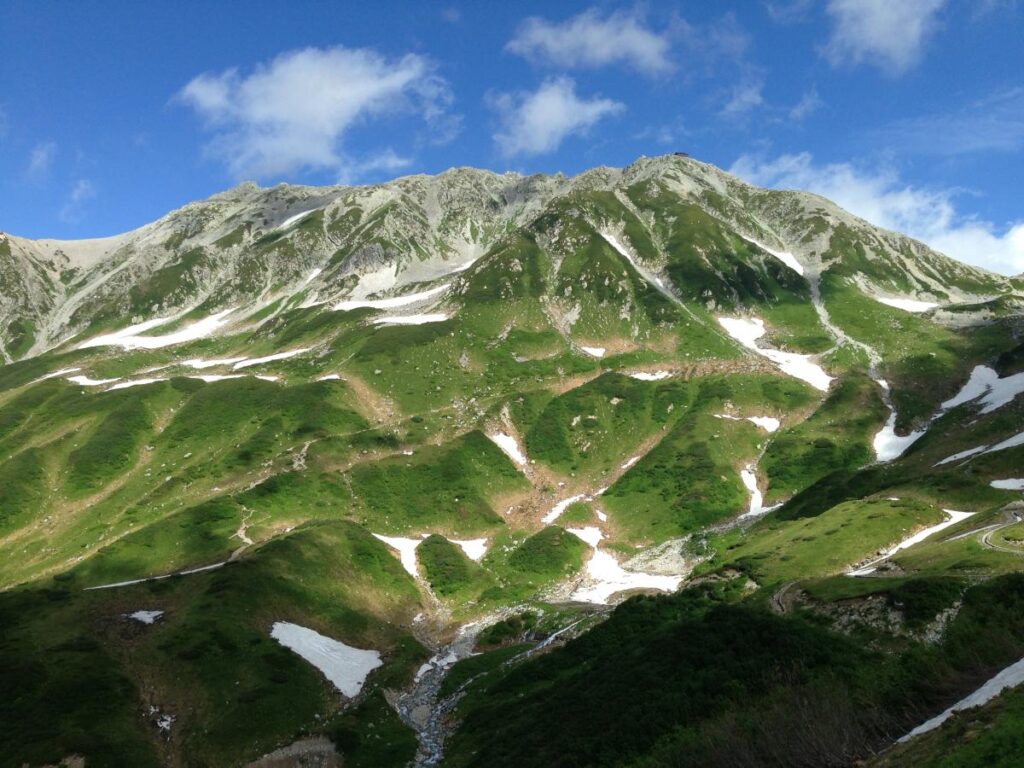
The Tateyama Mountain Range seen from the Kureha-yama Observation Deck
Hello everyone, I am Yasuhiko Takano, Director of the Toyama Prefectural Tateyama Museum.The sacred mountain Tateyama is believed to have been opened as a Buddhist mountain, a story that has been handed down as the Legend of the Founding of Tateyama. In this installment, I would like to introduce the essence of this legend as recorded in the Edo-period text Tateyama Ryaku Engi (Sōshinbō manuscript of Ashikuraji).
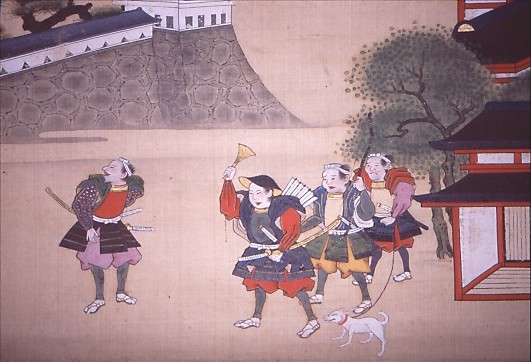
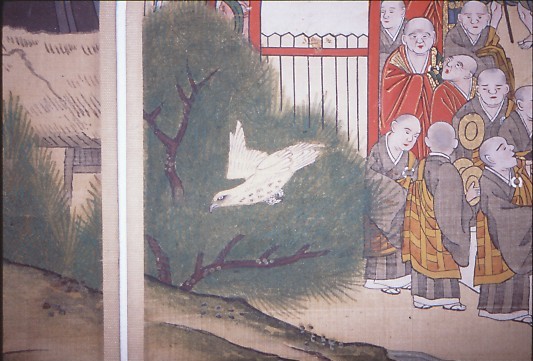
Arayori setting out for falconry (detail from the Tateyama Mandala, Daisenbō A version; collection of Daisenbō, Ashikuraji)
Chasing the Hawk
In 701 (the first year of the Taihō era), Saeki Ariwaka, acting under the orders of Emperor Monmu, was appointed provincial governor of Etchū Province. He established his residence at Fuse Castle along the Fuse River.
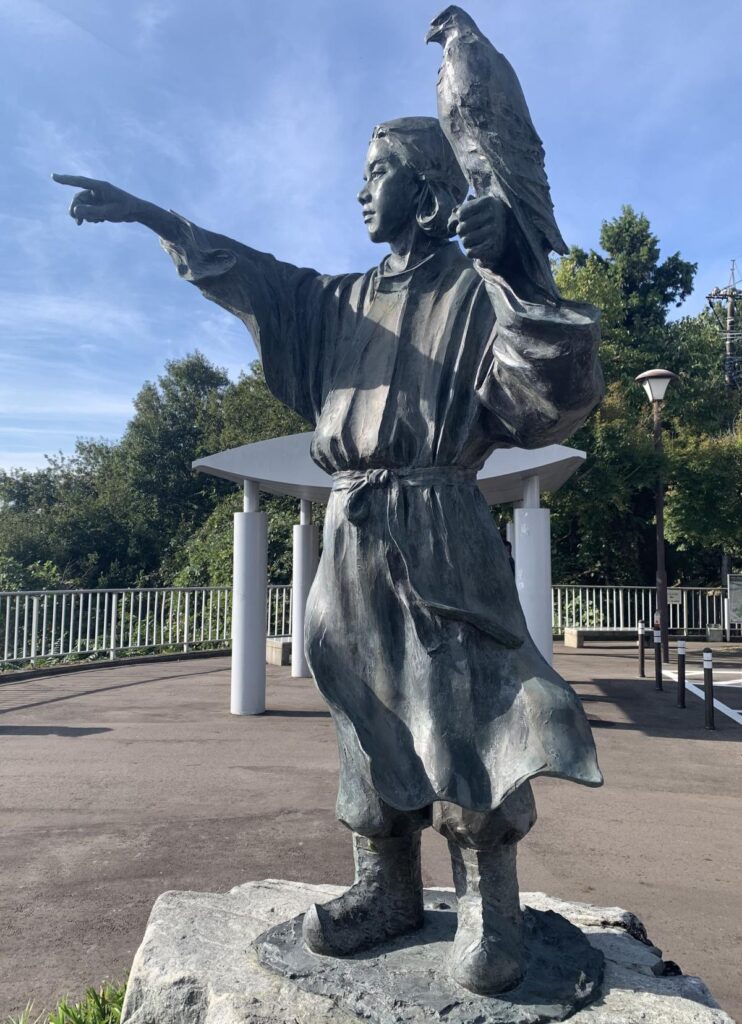
The following year, Ariwaka’s son Arayori took his father’s treasured white hawk and went out hunting. During the hunt, however, he lost the hawk. Enraged by the news, Ariwaka scolded his son harshly. Hoping to atone for his mistake, Arayori set out alone in search of the missing hawk.
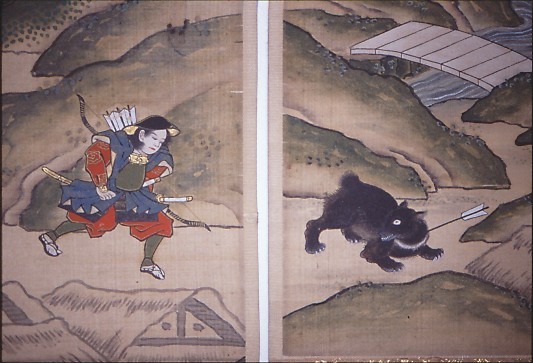
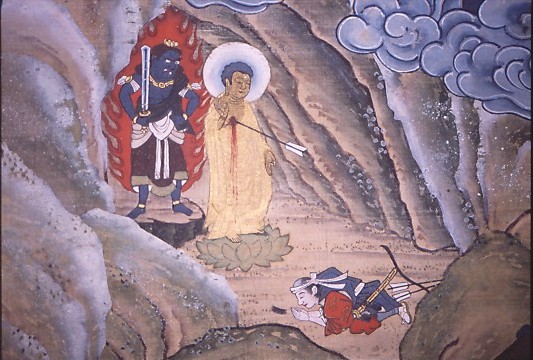
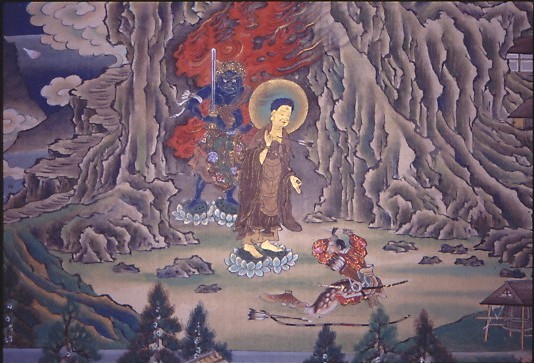
When he finally found it and rang a bell to call it back, a bear suddenly appeared and frightened the hawk, causing it to fly away once more. As the bear then charged at him, Arayori shot an arrow, striking the bear in the chest.
Arayori shooting an arrow at the bear (detail from the Tateyama Mandala, Daisenbō A version; collection of Daisenbō, Ashikuraji)
The fleeing white hawk (detail from the Tateyama Mandala, Daisenbō A version; collection of Daisenbō, Ashikuraji)
Chasing the Bear
The bear did not die. With the arrow still lodged in its body and blood flowing, it fled into the mountains. The white hawk also flew off in the same direction. Following the trail of blood, Arayori pursued the bear.
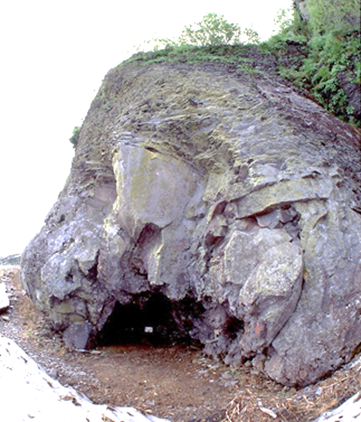
Along the way, an old man appeared to him in a dream and told him that the bear had entered the mountains of Tateyama. Venturing deep into the mountains, Arayori eventually saw both the bear and the hawk disappear into a cave known as Tamadenokutsu.
Inside the cave, Arayori encountered a golden image of Amida Buddha, accompanied by Fudō Myōō. To his astonishment, the arrow he had shot was embedded in the chest of Amida Buddha, from which blood was flowing. The bear was in fact Amida Buddha, and the white hawk was Fudō Myōō. Amida Buddha had been guiding Arayori in order to have Tateyama opened as a sacred mountain.Overcome with guilt at having wounded the Buddha, Arayori attempted to take his own life. At that moment, Yakusei Sennin, an immortal sage, appeared and stopped him. Arayori then renounced the secular world, took the Buddhist name Jikō, and devoted himself to rigorous ascetic practice. He opened mountain paths, built halls and lodgings, and established Tateyama as a Buddhist sacred mountain.
Arayori inside Tamadenokutsu Cave (detail from the Tateyama Mandala, Daisenbō A version; collection of Daisenbō, Ashikuraji)
Tamadenokutsu Cave at Murodō Plateau
The Changing Forms of the Founding Legend
In Edo-period versions of the founding legend, the young Saeki Arayori appears as the founder of Tateyama. However, earlier sources tell different stories.
In one of the oldest texts, the Iroha Jiruishō (ten-volume edition), the section titled The Original Account of the Manifestation of Tateyama Great Bodhisattva names Saeki Ariwaka, Arayori’s father, as the founder. In the Kamakura-period collection Ruijū Kigen Shō, in an entry on the Tateyama Gongen of Etchū Province, an unnamed hunter shoots a bear that transforms into Amida Buddha—making the founder a nameless hunter. This is likely the most primitive form of the legend.Later, in the Edo-period encyclopedia Wakan Sansai Zue, the founder is identified as Saeki Arayori. In this way, the founding legend appears to have evolved from a simple tale of a hunter, to one incorporating Saeki Ariwaka, who served as governor of Etchū in the early 10th century, and finally to the completed parent–child narrative centered on Arayori.
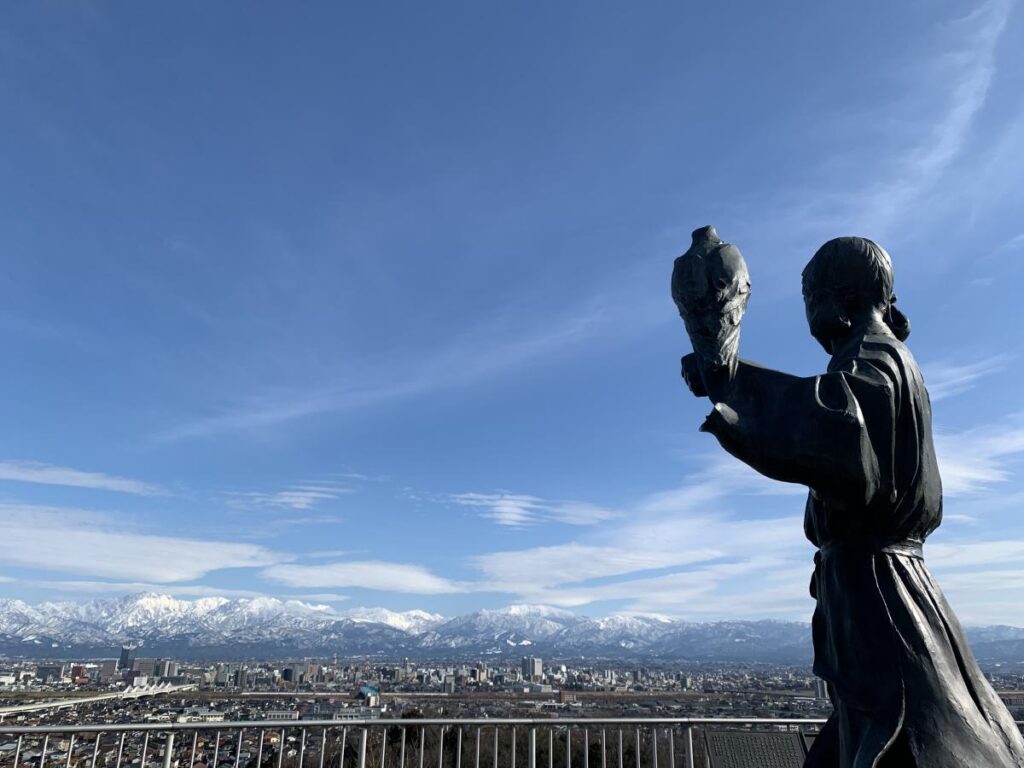
Statue of Saeki Arayori at the Kureha-yama Observation Deck
A Two-Part Legend: Chasing the Hawk and the Bear
The simple motif of a hunter pursuing a bear closely resembles the founding legends of Kumano Gongen. In the Sangoku Denki, the story of Kumano Gongen recounts how a hunter named Chikakane shot a bear, followed its blood trail, and encountered a golden Amida Buddha in a cave—an episode marking the beginning of Kumano faith.
Similar legends that feature hunters as founders can be found at other sacred mountains, including Mount Kōya, Mount Daisen in Hōki Province, and Mount Hikosan.
What distinguishes the Tateyama founding legend, however, is its two-part structure: first the pursuit of the hawk, followed by the pursuit of the bear. This distinctive composition may provide an important clue for understanding forms of Tateyama faith that predate its opening as a Buddhist mountain.
In the next installment, we will explore stories of Tateyama Hell as they appear in Heian-period Buddhist tales. I hope you will continue to follow this series.Written by Yasuhiko Takano Director, Toyama Prefectural Tateyama Museum
Editorial Note
At the Toyama Prefectural Tateyama Museum, the story of Saeki Arayori is presented in detail through digital signage. The museum also features a full-scale diorama of Tamadenokutsu Cave, allowing visitors to experience the legendary encounter with Amida Buddha. We invite you to explore the world of the Tateyama founding legend firsthand.
#https://www.yamanohi.net #Toyama Prefectural Tateyama Museum #Mountain Faith #Mt Tateyama # Falconry # Amida Buddha # Fudō Myōō
Tateyama faith is the belief in the existence of hell within the mountains. The concept of hell at Tateyama is thought to have emerged from the ancient Japanese belief that the souls of the dead go to the mountains, combined with Buddhist ideas of the afterlife. In this installment, I will introduce Buddhist tales of Tateyama Hell that appear in late Heian-period works such as the Hokke Genki and the Konjaku Monogatari-shū.
Jigokudani (Hell Valley), Tateyama
Jigokudani: The Hell Valley of Tateyama
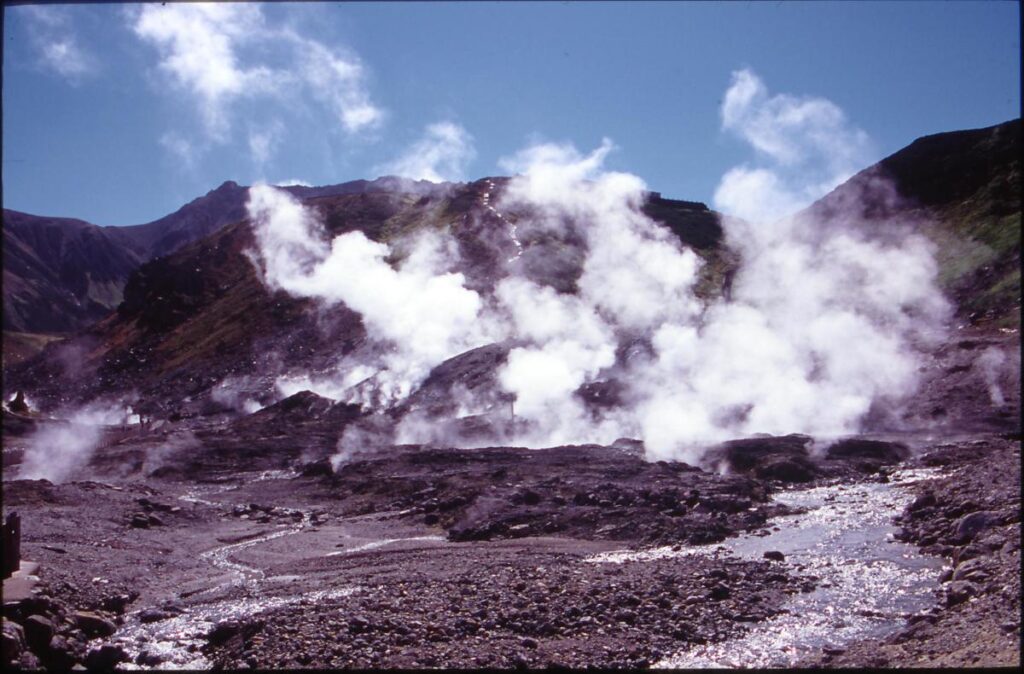
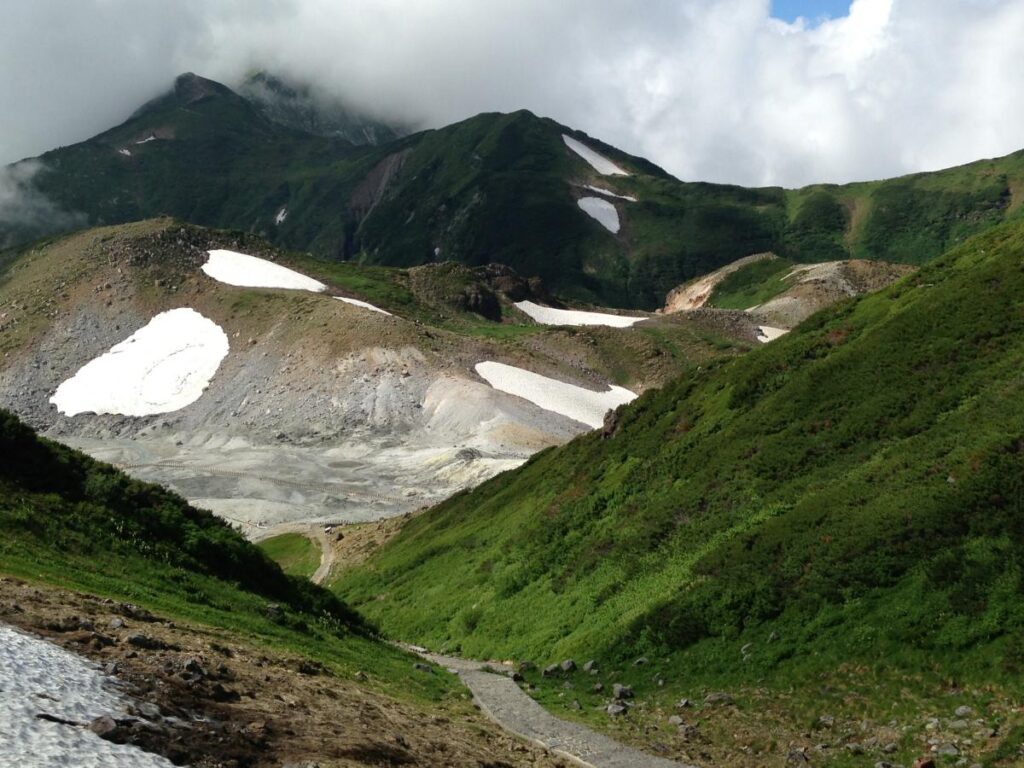
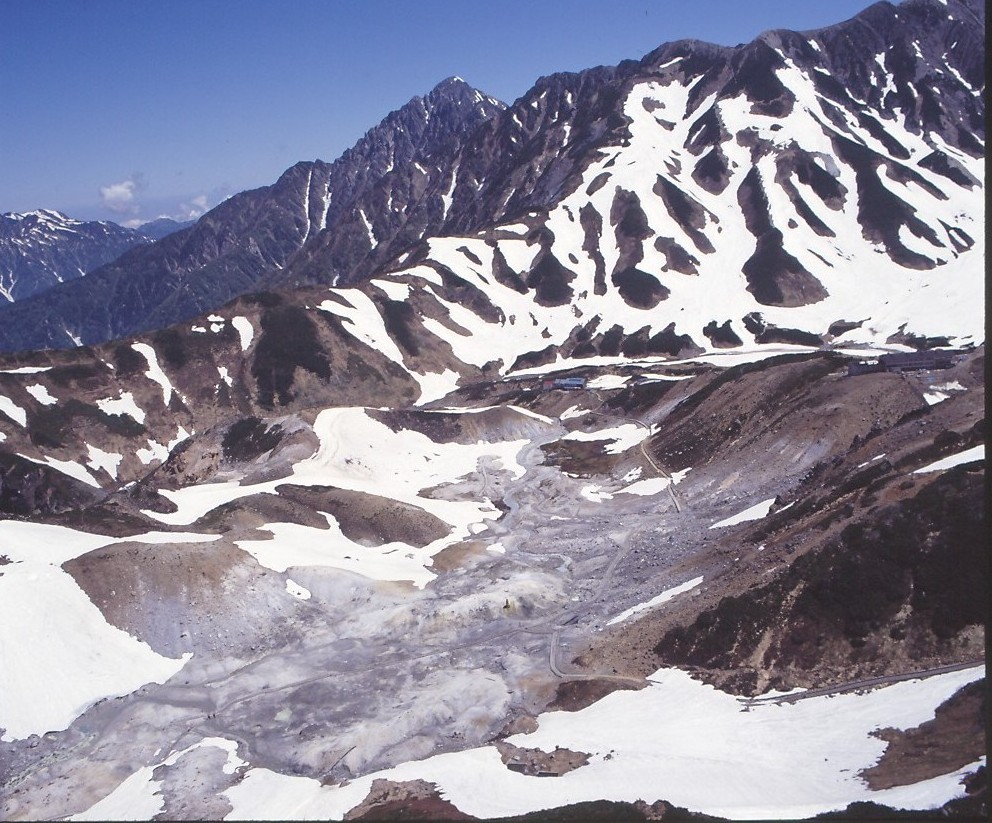
Volcanic activity at Mount Tateyama (the Midagahara Volcano) is believed to have begun approximately 220,000 years ago. Around 100,000 years ago, repeated large-scale pyroclastic eruptions formed the Midagahara Plateau. After about 40,000 years ago, phreatic explosions created craters that became Jigokudani (Hell Valley), Mikurigaike Pond, Midorigaike Pond, and other features.
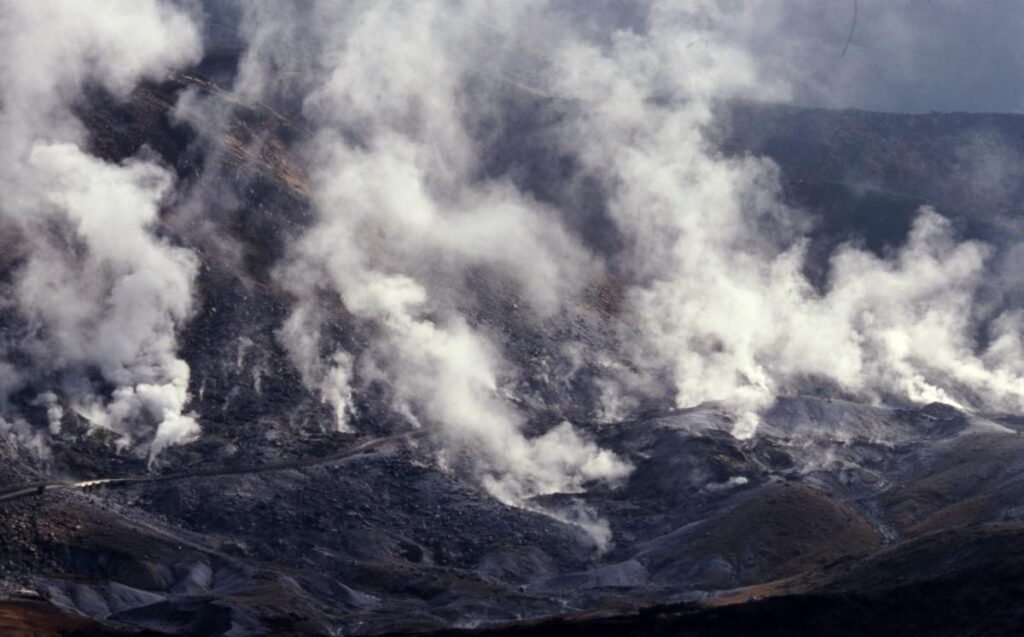
In Jigokudani today, pools of boiling water and vents emitting volcanic gases can be seen throughout the area. Bright yellow sulfur crystals formed by sublimation are scattered across the landscape, and the pungent odors of hydrogen sulfide and sulfur dioxide fill the air, creating an eerie and unsettling scene.
During the Heian period, mountain ascetics who traveled among sacred mountains throughout the country likely witnessed these extraordinary landscapes and conveyed stories of Tateyama’s hell back to the capital. The Konjaku Monogatari-shū records that “people of Japan who committed sins were often sent to the hell of Tateyama,” indicating that among aristocrats and monks in the capital, Tateyama was widely recognized as a place where hell existed.
Mikurigaike Pond, formed by volcanic activity
A Tale of Tateyama Hell in the Heian Period (1)
In Dai Nihon-koku Hokke Genki, Volume II, Tale 124, titled “The Woman of Tateyama in Etchū Province,” the following story is told.
An ascetic visiting Tateyama encounters a young woman in the mountains. She explains that she is the daughter of a Buddhist sculptor from Gamo District in Ōmi Province (present-day Shiga Prefecture) and that she fell into hell after death for the sin of selling Buddhist objects to support her own livelihood.
She further explains that she is able to leave hell temporarily because, during her lifetime, she had prayed to Kannon and observed a single day of vegetarian fasting. Because of this good deed, Kannon takes her place in hell once each month on the eighteenth day, bearing the suffering on her behalf. She entrusts the ascetic with a message for her parents. After hearing this message, her family commissions the copying of the Lotus Sutra as a memorial offering, and through this merit, the woman is reborn in Trāyastriṃśa Heaven, one of the celestial realms.
A nearly identical story appears in Volume 14, Tale 7 of the Konjaku Monogatari-shū.
Volcanic landscape around Jigokudani, Tateyama and Mt Tsurugi
A Tale of Tateyama Hell in the Heian Period (2)
In Volume 17, Tale 27 of the Konjaku Monogatari-shū, another story is recorded.
An ascetic named Enkō, who is practicing austerities in the mountains of Tateyama, encounters a figure at around two o’clock in the morning. The figure introduces herself as a woman from Shichijō in Kyoto and explains that she died young and fell into the hell of Tateyama.
She recounts that during her lifetime she attended the Jizō devotional gatherings at Gidarin-ji Temple once or twice. Because of this good deed, Jizō Bodhisattva descends into hell and endures the suffering in her place three times a day—morning, noon, and night. She entrusts Enkō with a message for her family, who then create an image of Jizō Bodhisattva and copy the Lotus Sutra. As a result, the woman is saved from her suffering.
This tale was later illustrated during the Kamakura period and is now preserved as the Illustrated Scroll of the Miracles of Jizō Bodhisattva in the Freer Gallery of Art in the United States.
Jigokudani (Hell Valley), where volcanic gases continuously rise from the ground
A Tale of Tateyama Hell in the Heian Period (3)
Another story set in Tateyama Hell appears in Volume 14, Tale 8 of the Konjaku Monogatari-shū.
A government clerk from Etchū Province (present-day Toyama Prefecture) performs memorial services on the forty-ninth day after his wife’s death. Later, his three children, together with a holy man, climb Tateyama to mourn their mother. Upon reaching Tateyama Hell, they hear her voice.
Their mother asks them to commission the copying of one thousand volumes of the Lotus Sutraas an offering in order to escape from hell. This request reaches the ears of the provincial governor. After the copying is completed and a Buddhist service is held, the family receives a revelation in a dream that the mother has been reborn in Trāyastriṃśa Heaven.
The Meaning of Tateyama Hell Tales
In these Heian-period tales, women who have fallen into hell appear either within Jigokudani or elsewhere in the mountains of Tateyama. In every case, they are saved from suffering through memorial offerings based on the copying of the Lotus Sutra, which was believed to extinguish sins.Stories associated with Tateyama Hell continued to be created in various forms in later periods, and Tateyama became widely known as “the mountain where hell truly exists.” During the Edo period, this reputation further developed into the image of Tateyama as a mountain of salvation for women, attracting widespread devotion among female believers.
Statue of Jizō Bodhisattva, believed to save beings suffering in hell
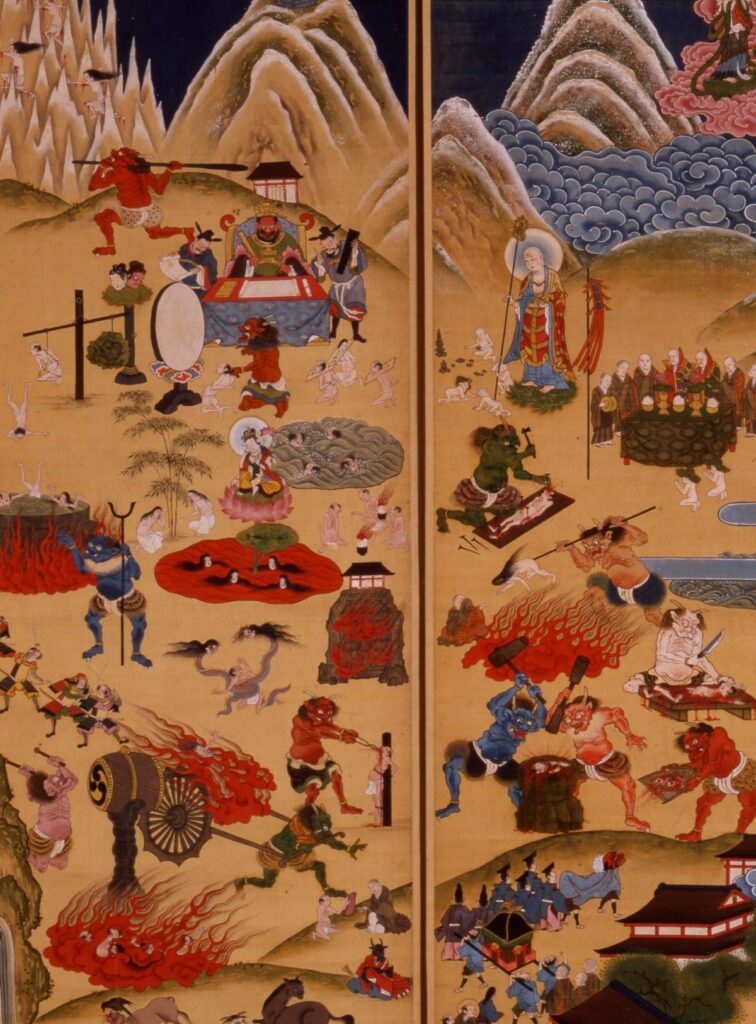
Scenes of hell depicted in the Tateyama Mandala
Illustrated representations of Tateyama Hell
In the next installment, we will explore Taishakuten and King Enma in the context of Tateyama faith. I hope you will continue to follow this series.
Written by Yasuhiko Takano Director, Toyama Prefectural Tateyama Museum
Editorial Note
At the Toyama Prefectural Tateyama Museum, tales of Tateyama Hell are presented in an easy-to-understand format through interactive touch-panel displays. We also recommend several exhibition catalogs, including Tateyama in Literature, A Tour of Hell, and Tateyama × Hell Exhibition. For purchase details, please contact the Toyama Prefectural Tateyama Museum.
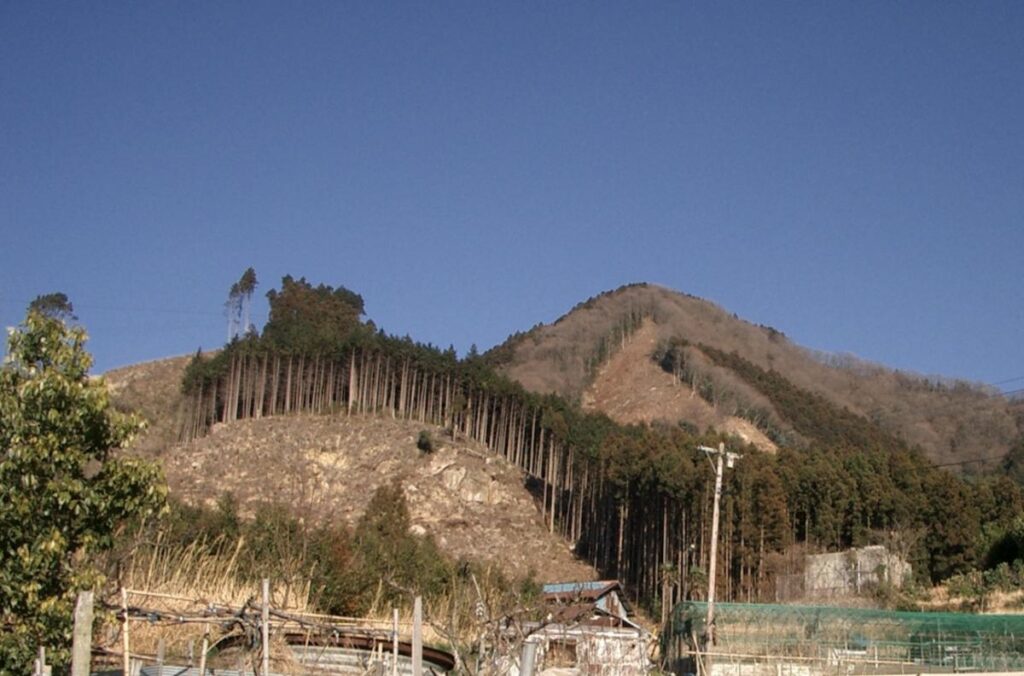
This Millennium Forest did not begin as a project. It began with one person standing before a clear-cut hillside, asking how a human being should relate to nature— and over what span of time.
Rather than seeking quick answers, or attempting to control outcomes, a simple choice was made: to plant trees, and to entrust time to nature.
A forest does not respond immediately. Yet to those who continue to stand with their questions, it eventually begins to speak—quietly, through its form.A Millennium Forest is not only an act of reforestation. It is a place where one learns, over a lifetime, what it means for humans to live alongside nature.
Life Devoted to Forest Creation
In this three-part essay series, Takeo Tsurumi reflects on a life devoted to forest creation— a journey shaped not by a single project, but by decades of quiet commitment to land, time, and learning from nature.
Born in 1946 to parents who returned to Japan from Manchuria after the Second World War, Tsurumi grew up in a postwar reclamation village, where life was marked by material poverty and hardship. These early experiences formed a lifelong sensitivity to the relationship between human survival, land, and time.
Over nearly fifty years, he has continued to engage in forest creation as a personal, long-term practice rather than a short-term intervention—planting trees, observing change, and allowing natural processes to unfold beyond human control.
A former professor at Ehime University with a Ph.D. in Economics, Tsurumi’s work bridges lived experience, academic inquiry, and hands-on forest practice. Through the creation of the Millennium Forest, he has come to see forests not as resources to be managed for immediate results, but as teachers—revealing, over time, how humans might live more humbly and responsibly alongside nature.
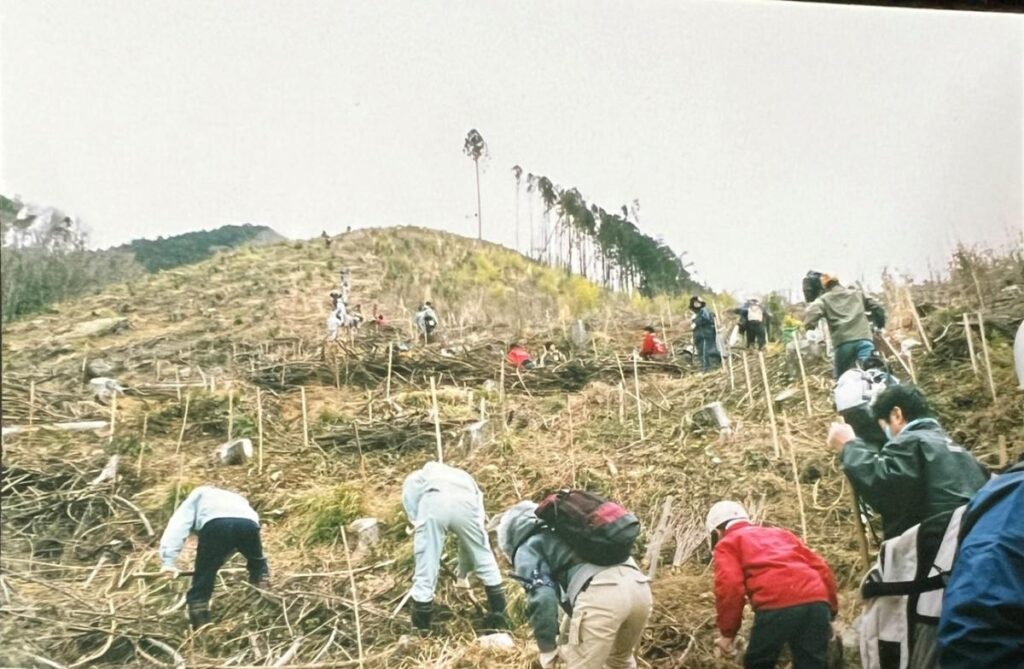
Kawauchi Millennium Forest:At the time of purchase
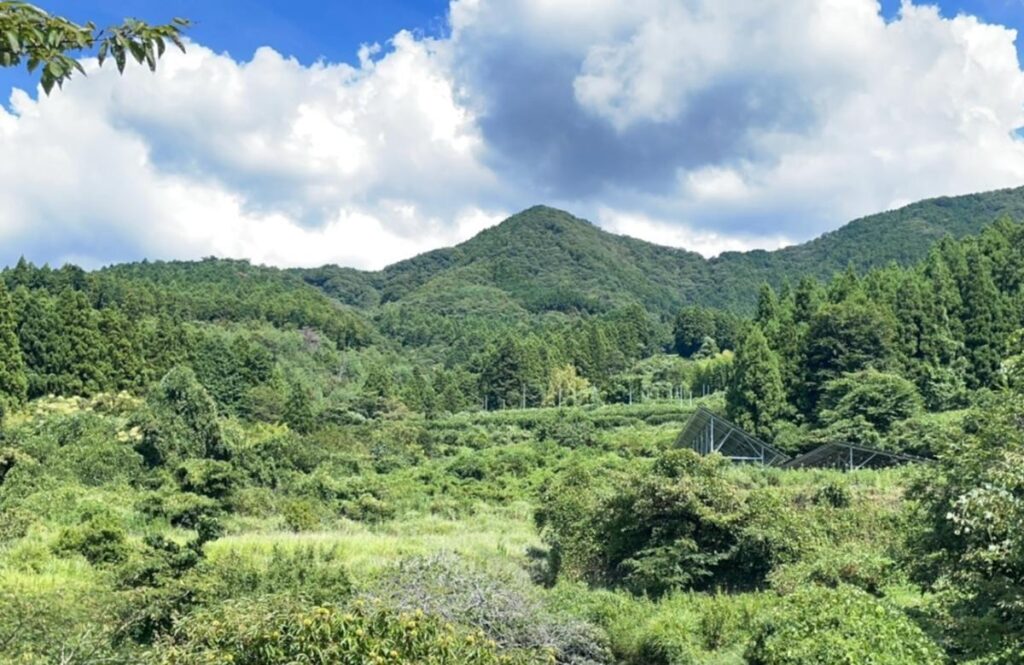
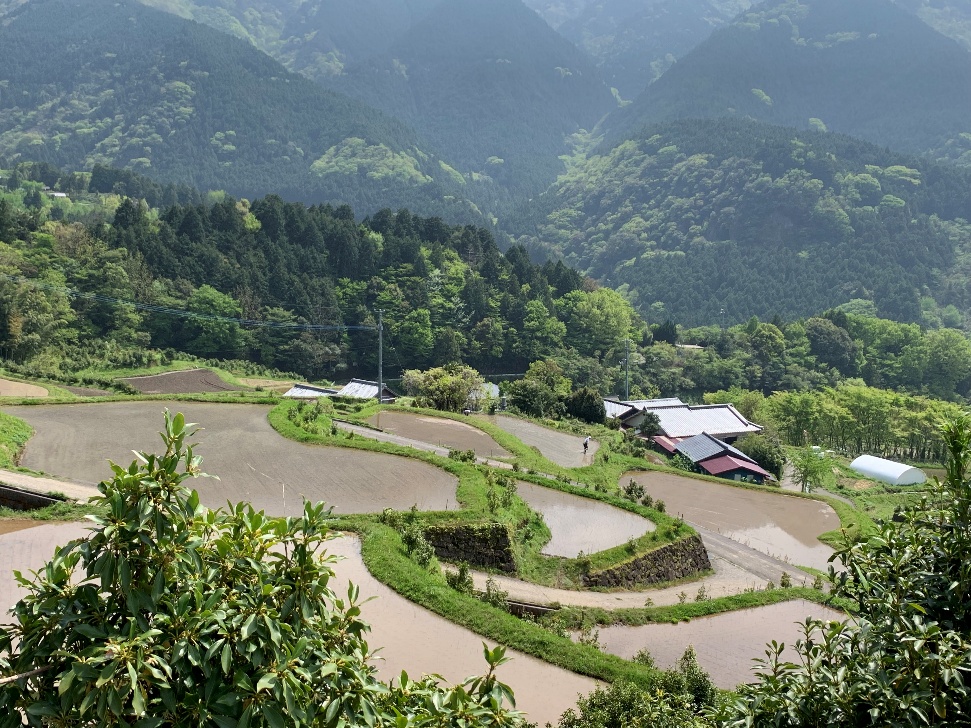
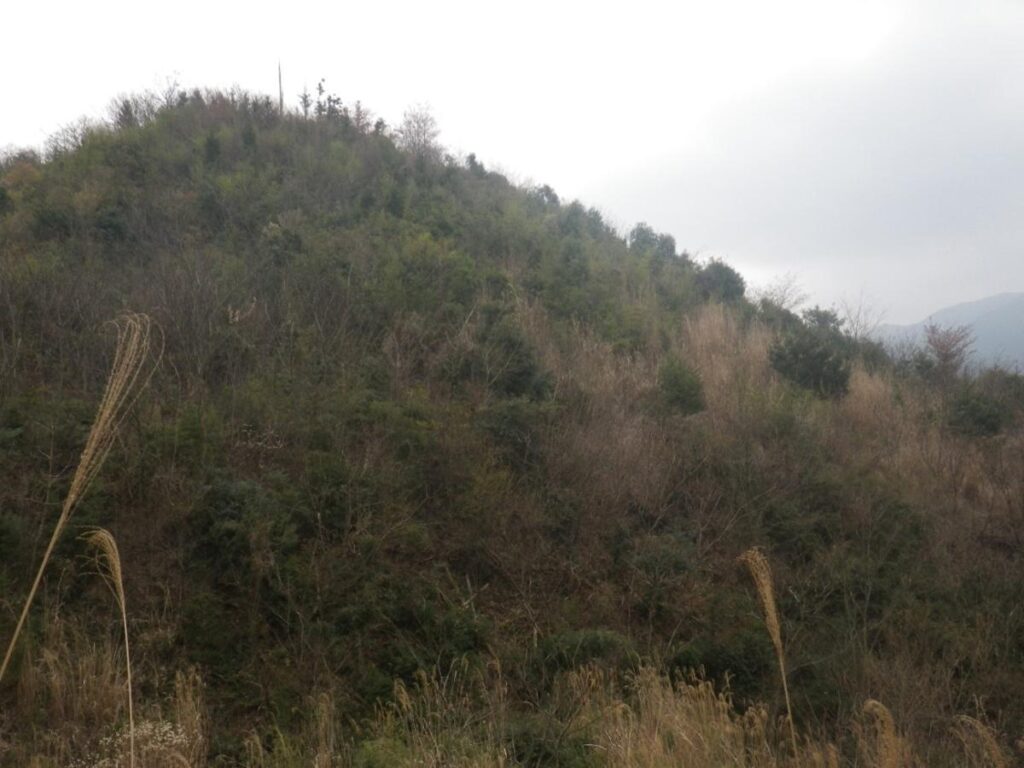
Kawauchi Millennium Forest: 20 Years Later, 2024
Part 1 — Origins of the Thousand-Year Forest
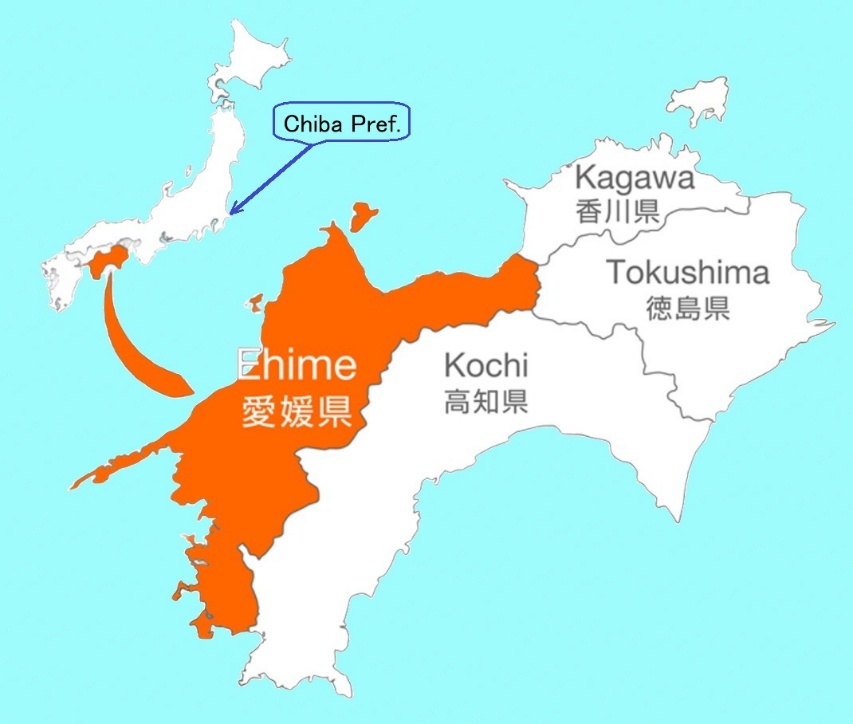
In the late 20th century, while teaching at an agricultural high school in Chiba, I began helping a friend manage a small forest. One day I saw an industrial waste site in the mountains, leaking toxic liquid into a valley stream. I realized then: once nature is destroyed, it may take a thousand years to heal. From this conviction, the idea of creating a “Thousand-Year Forest” was born.
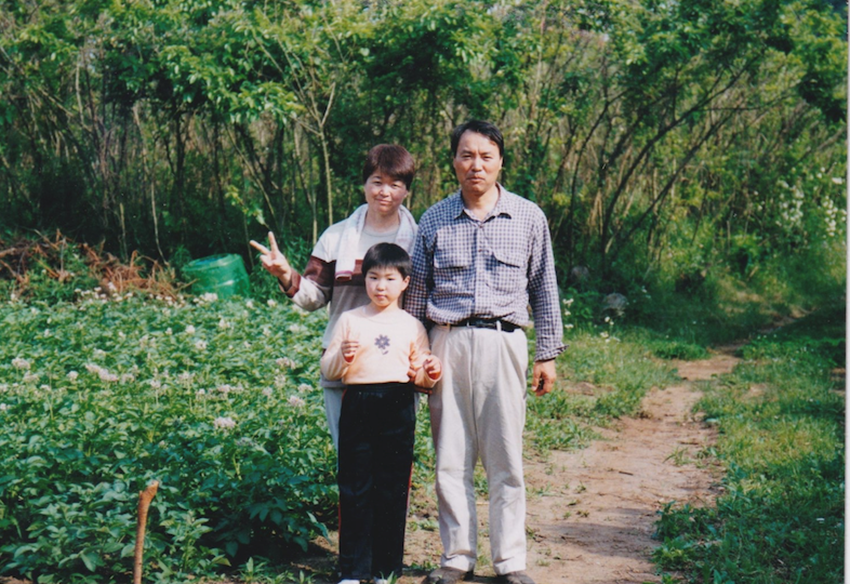
Life in Chiba with My Family
In 2000, I moved to Ehime Prefecture to take a university post. By chance, I purchased an old farmhouse in the terraced hills, where neighbors warmly welcomed my family and taught us how to cultivate rice. Soon after, I acquired six hectares of bare land nearby. For the first time, I had a place to plant freely, and together with volunteers we began restoring the mountain.
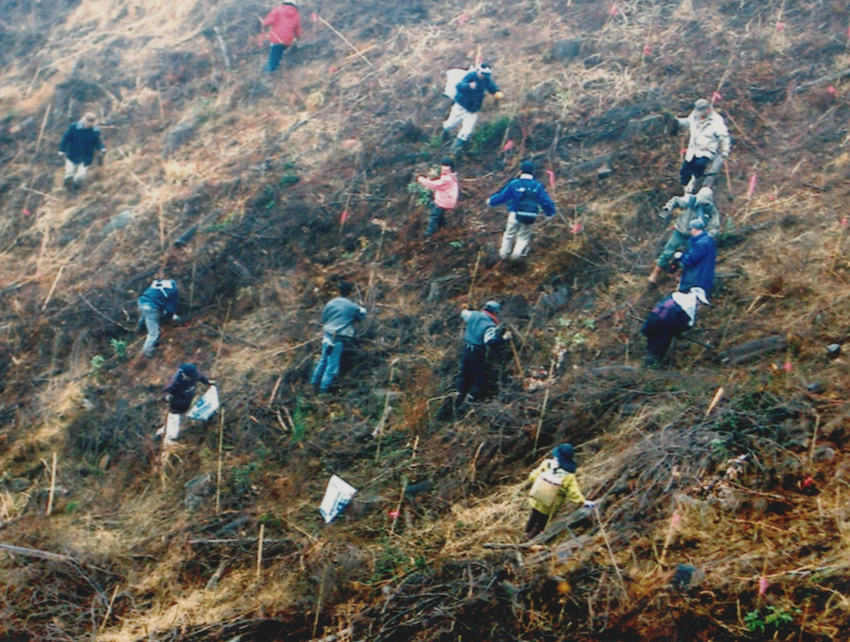
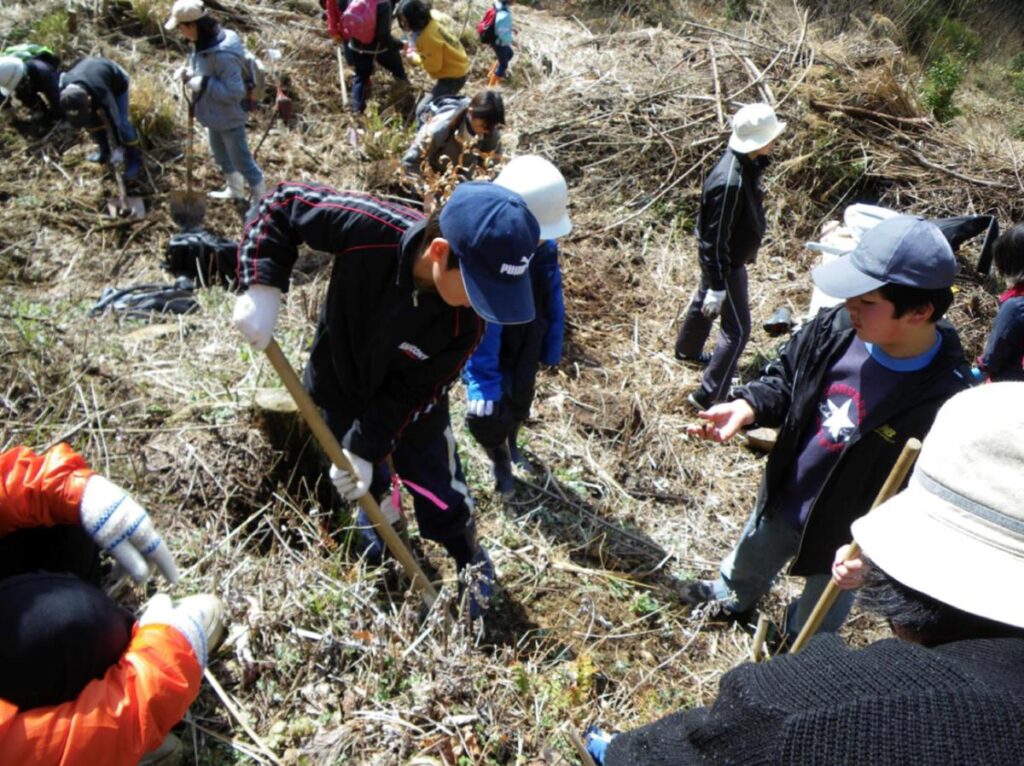
Over the years, we planted more than 9,000 broadleaf trees. Families joined to mark life events, children planted camellias as graduation memories, and couples planted trees for anniversaries. Each tree became more than a seedling; it carried human hopes and stories.What began as one professor’s personal commitment slowly grew into a community’s shared vision. The Thousand-Year Forest is not just a piece of land—it is a living symbol of care, resilience, and the belief that our actions today can shape a forest for generations a thousand
Forestation at Chihara Millennium Forest, Year 2003
Learning from the Forest
Ten years after intensive planting and maintenance began in the Kawauchi Millennium Forest, we asked a simple question: What had the forest become? In 2014, after years spent preparing the land, planting trees, clearing undergrowth, and cutting vines across seven hectares of the ten-hectare site, we commissioned a professional forest survey.
At the time, I carried a sense of unease. Maintenance had not always been as thorough as I wished. Yet the survey results surprised and reassured me. The forest was described as “a good forest,” already developing rich biodiversity. Even when our human efforts had been limited, natural processes had continued to nurture the land. This realization brought both encouragement and relief.Ten years later, in 2024, we asked the same researcher to return. The second survey, focusing explicitly on the monitoring of broadleaf forests regenerating on former conifer clear-cut sites, reflected a deeper and more focused understanding than the first. Our questions had matured, and so had the forest.
Site preparation on former clear-cut sugi and hinoki plantation sites
Learning Through Science and Education
Between these two surveys, my own thinking underwent a significant transformation. From 2015 to 2018, I was involved in developing national high school curriculum guidelines in forestry, covering forest science, forest management, and forest product utilization. From 2019 to 2021, I authored the high school textbook Forest Science.
These years became a period of intensive learning for me. During the textbook’s preparation, I received frequent guidance from Professor Takao Fujimori, a leading forest ecologist. His advice was clear: forest ecosystem functions and services must be explained as a coherent story—one that shows how they can be harmoniously realized through appropriate management, and what kinds of technologies, human resources, and policies are needed to support them.While writing under strict deadlines, I often found myself watching ripe apricots fall from the single tree in our yard, slowly decaying in the terraced rice fields below. That quiet image became inseparable from my understanding of time, cycles, and patience in both forests and human learning.
Forestation Kawauchi Millennium Forest
Kawauchi Millennium Forest, 10 years later
Clarifying the Goal
The insights gained through study and practice gradually crystallized into a clear direction for the Millennium Forest. Our ultimate target forest type would be a natural forest. We defined our objective as the conversion of clear-cut sugi (Japanese cedar) and hinoki (Japanese cypress) plantations into broadleaf forests.
As activities progressed, the forest was divided into eight zones, each with a provisional target: planted forest, semi-natural forest, or natural forest. This zoning allowed us to continue learning through long-term observation rather than fixed prescriptions.
At the conclusion of the survey report, the researchers noted that clear management guidelines for volunteer-led broadleaf forest creation remain largely undeveloped. In that context, they expressed respect for the Kawauchi Millennium Forest as a rare long-term experiment—one that continues through trial and error under diverse natural conditions.
What the Forest Teaches
Part 2 marks a shift from doing to learning. The forest is no longer something we shape alone; it is something that responds, teaches, and quietly corrects us over time. Through observation, study, and humility, the Millennium Forest has become not only a site of restoration, but a living classroom—one that continues to deepen our understanding of forests, people, and the long arc of coexistence between them.
What does it truly mean to create a Millennium Forest? By 2024, our answer has become clearer: it is not only about trees, but about people—and the relationships that grow alongside the forest.
Children planting trees
A Forest That Welcomes the Whole Person
From the beginning, the Ehime Millennium Forest Association has followed a simple principle: participation is never obligatory. People may join as much or as little as they wish, according to their interests, concerns, and physical condition at the time. We do not evaluate or rank participants by experience, skill, enthusiasm, or attitude.
For those unfamiliar with forestry, volunteer work in the forest can feel intimidating. We therefore place great importance on creating an environment where anyone can participate with a sense of safety and ease.
Within such an atmosphere, participants gradually gain emotional space. As they encounter their unadorned selves, many begin to reflect quietly on a deeper question: What is my own role, or purpose, in life?
Sharing Time, Sharing Awareness
We value group sharing sessions held at both the beginning and the end of each activity day. At the opening session, participants talk about recent experiences, thoughts, or feelings they bring with them. At the closing session, each person reflects on what they experienced during that day in the Millennium Forest.
Through these simple practices, individual awareness is shared, and mutual understanding deepens naturally. Over time, these repeated moments of reflection have strengthened two core aspirations of the Association: to provide a place where people can encounter their true selves, and to explore future-oriented, circular ways of living.The Millennium Forest is gradually becoming an irreplaceable place—not merely a forest to be managed, but a space for profound human and ecological experience.
Kawauchi Millennium Forest- Broadleaf Area、20years later (Year 2024)
Continuing the Work, Together
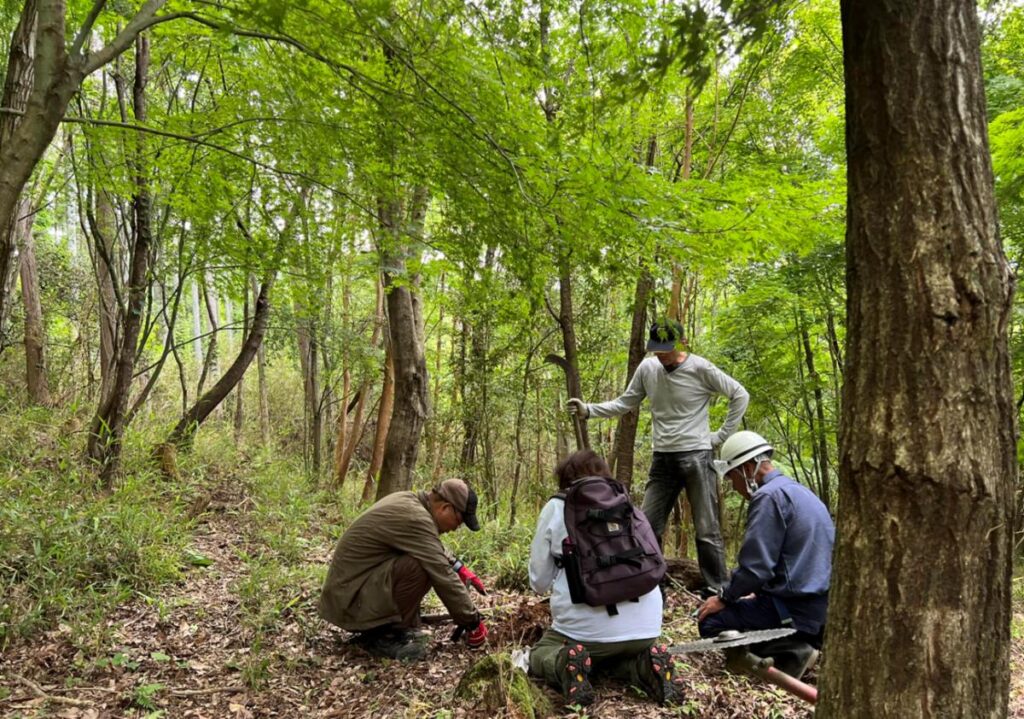
Forest volunteer activities are held once a month, usually on the third Saturday. Tasks include maintaining walking paths, cutting bamboo grass, and removing vines. As I grow older, working across ten hectares has become physically demanding, and I am deeply supported by the presence of fellow volunteers.We also create opportunities for forest observation and hands-on experiences whenever possible. For us, entering the forest has become part of everyday life. For participants from urban areas, however, stepping into the forest—often for the first time—can be a powerful and moving experience in itself.
Entering the forest together
Learning from the Living Forest
Perhaps out of a sense of curiosity, I also try to share what the forest has taught me: how forest ecosystems provide diverse functions and services, and how these functions change as forests develop over time. Participants listen, reflect, and gradually incorporate these ideas into their own understanding of forest creation.Part 3 represents a shift from making a forest to living with one. Here, the Millennium Forest reveals its deeper meaning—not as a completed achievement, but as an ongoing practice in which forests shape people, just as people care for forests.
Prologue:
This three-part essay series presents the life and work of Takeo Tsurumi, who has devoted his life to forest creation.He did not begin this work to be understood, nor to be evaluated beyond his own conscience. He simply continued, believing that time itself would respond.
# Professor Takeo Tsurumi PhD, (retired) # Ehime University # Ehime Prefecture # Reforestation
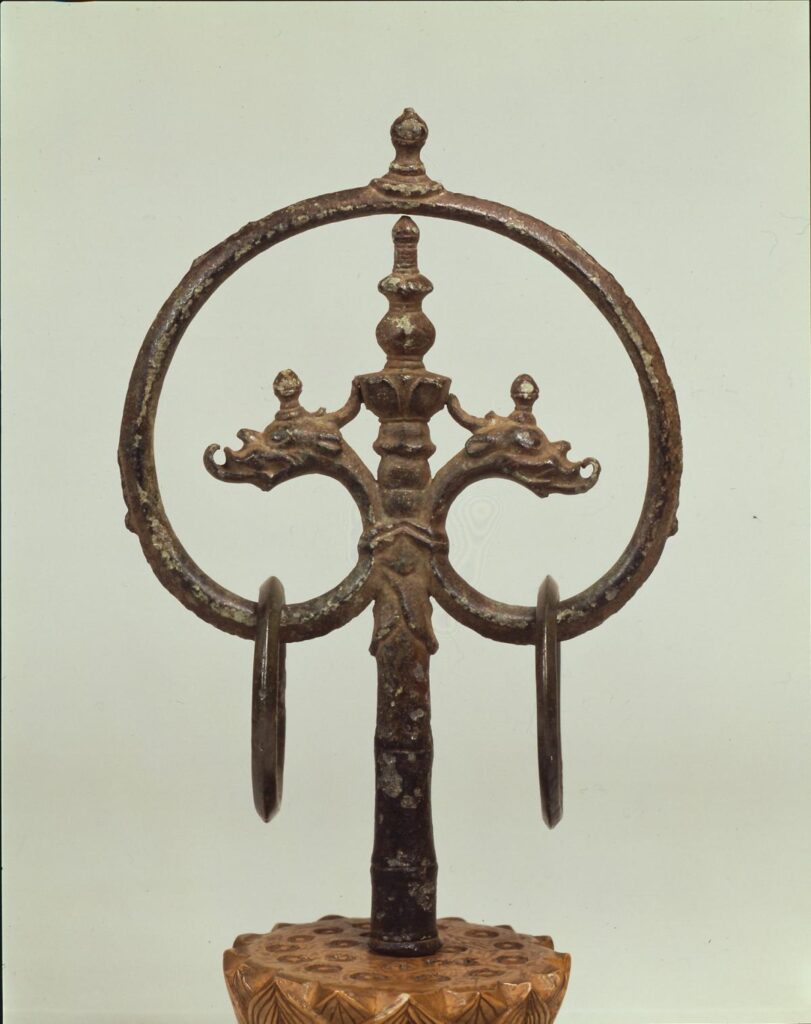
Bronze ritual staff finial with twin-dragon decoration, discovered on Mt. Dainichi, Toyama Prefecture (Collection of the Toyama Prefectural Tateyama Museum)
Hello everyone, I am Yasuhiko Takano, Director of the Toyama Prefectural Tateyama Museum.In the previous installment, we explored how Tateyama was revered from afar as a sacred mountain during the Nara period. This time, we turn to the Heian period to see how Tateyama’s religious character further evolved.
The Emergence of Oyama Deity
During the Heian period, the deity of Tateyama was gradually incorporated into the state religious system as a guardian of the nation. In the historical chronicle Nihon Sandai Jitsuroku, an entry dated 863 (Jōgan 5) records that Oyama Deity was granted the court rank of Junior Fifth Rank, marking the first appearance of Tateyama’s god in official documents.Later, the Engishiki—completed in 927—lists seven shrines in Niikawa District, including Oyama Shrine. These records indicate that, by the Heian period, the deity of Tateyama had been formally recognized and worshipped as a state deity. However, it remains unclear whether the Oyama Shrine of that era stood in the same location as the present shrine.
A Ritual Staff Finial Discovered on Mt. Dainichi
The Heian period is also thought to be the time when Buddhist practices became closely associated with Tateyama, transforming it into a site of ascetic training.
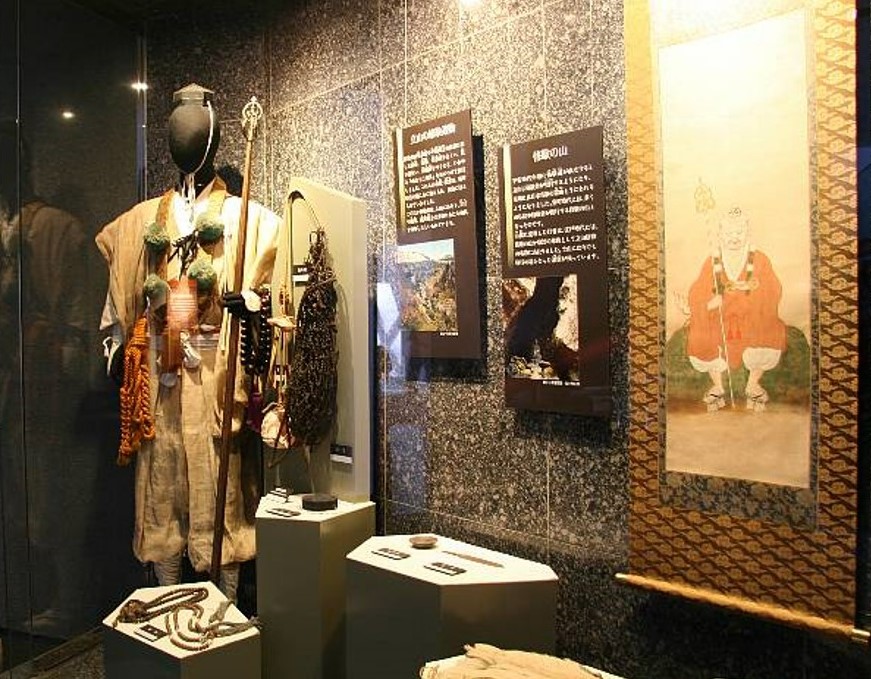
In July 1893, a ritual staff finial (shakujōtō) dating to the late Heian period was discovered on Mt. Dainichi. The artifact was found by Isotarō Kawai during a mountain expedition undertaken in search of hot springs, together with three guides. A shakujō is a ritual staff used by mountain ascetics who practiced in remote and rugged terrain. It functioned as a walking aid and as a tool to make sound to ward off wild animals, but it also held important religious significance.The metal fitting attached to the top of the staff is known as a shakujōtō. The example discovered on Mt. Dainichi—decorated with twin dragons—was designated an Important Cultural Property of Japan in 1963. Its distinctive features include a slightly swollen ring and dragon heads crowned with sacred jewels, connected by softly curling vine-like forms.
A mountain ascetic (figure) and a ritual staff (shakujō)
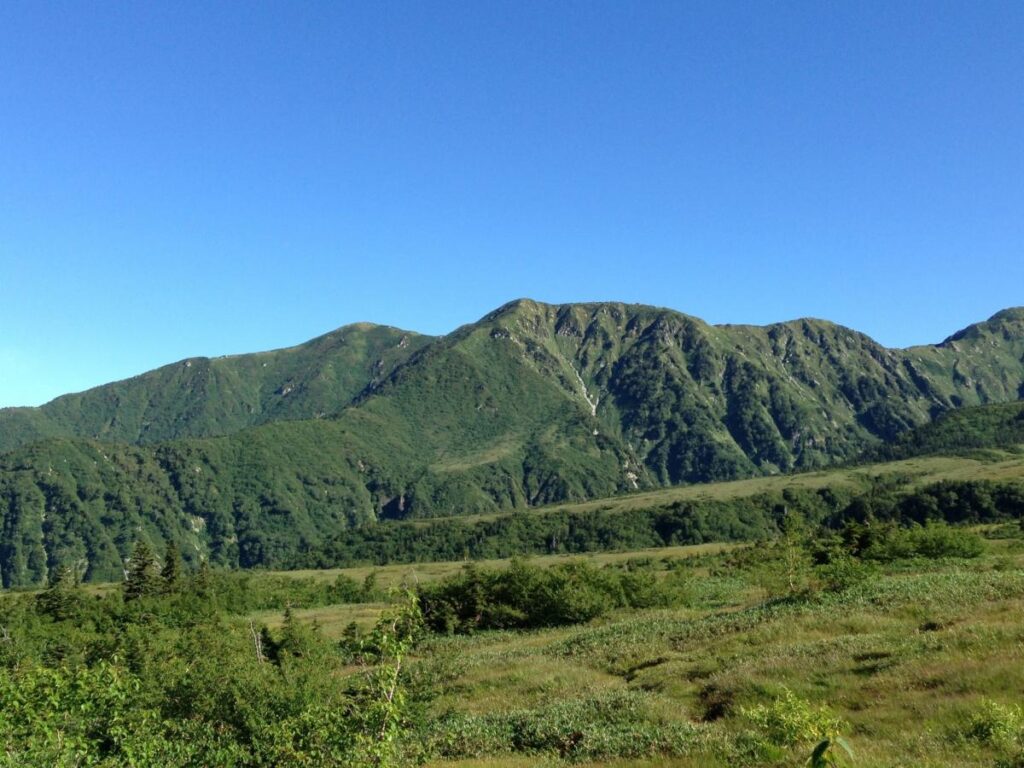
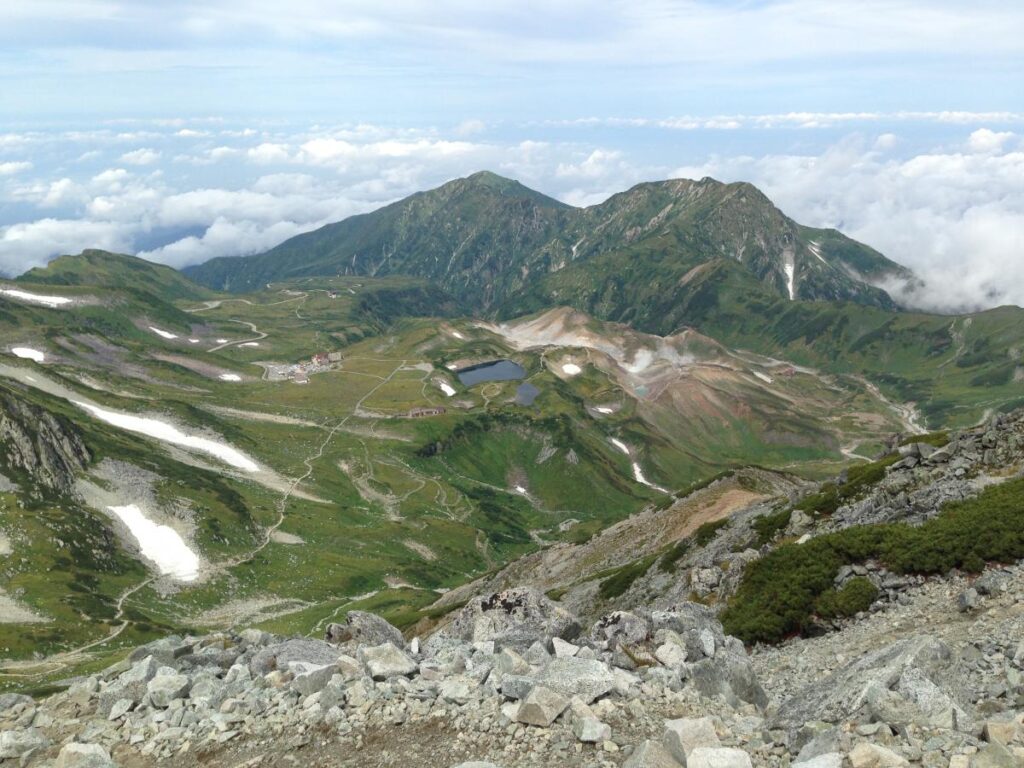
Mt. Dainichi seen from Midagahara Plateau
Ritual Objects Discovered on Mt. Tsurugi
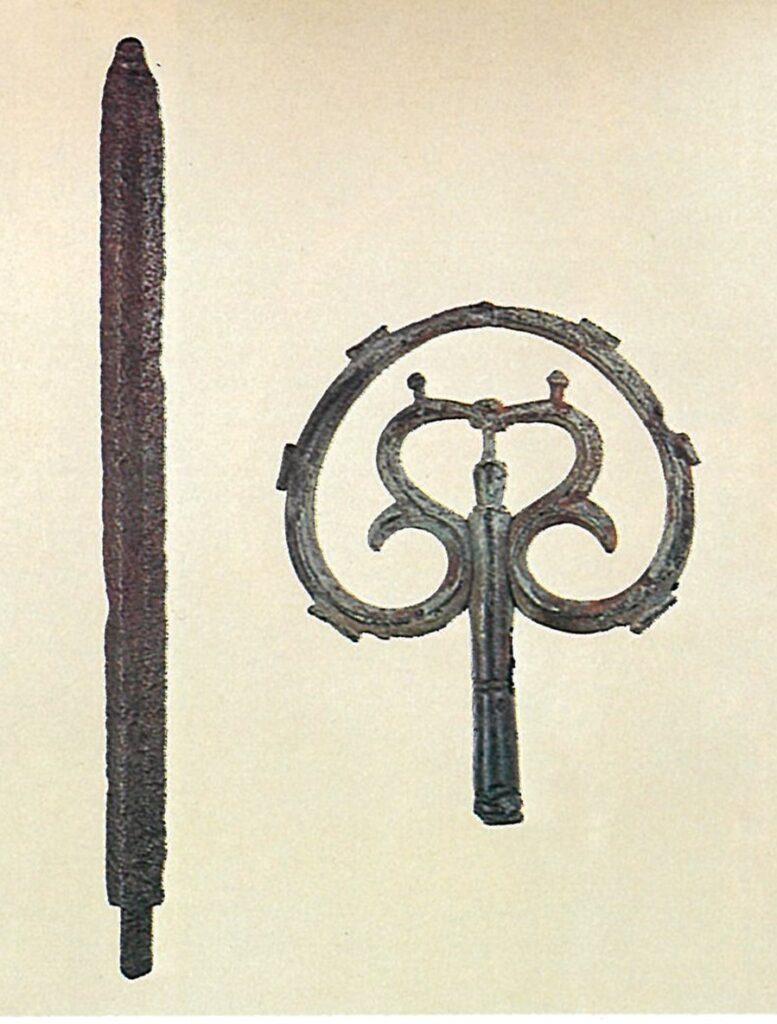
In July 1907, Yoshitarō Shibasaki of the Army General Staff Office’s Land Survey Department reached the summit of Mt. Tsurugi, which was then believed to be unclimbed. During this ascent, he discovered another ritual staff finial along with an iron sword.
This episode later became widely known through Jirō Nitta’s novel Tsurugidake: Ten no Ki and its film adaptation directed by Daisaku Kimura. The ritual staff finial with iron sword found on Mt. Tsurugi is believed to date to the early Heian period and was designated an Important Cultural Property in 1959. The finial features a fan-shaped ring with fern-scroll motifs curling inward at the base, giving it a powerful and robust impression. In 1982, the artifacts were donated to Toyama Prefecture through the generosity of the Shibasaki family.The ritual staff finials discovered on Mt. Dainichi and Mt. Tsurugi are among the most important archaeological remains for understanding the development of sacred mountain worship in Japan.
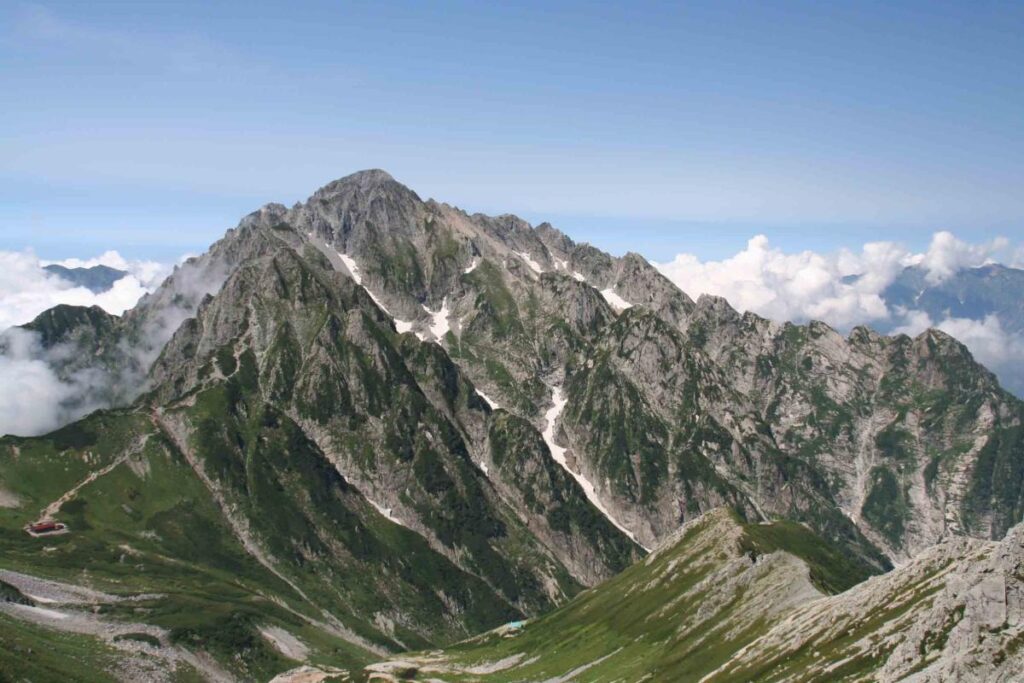
Mt. Tsurugi seen from the summit of Mt. Bessan
Bronze ritual staff finial with iron sword, discovered on Mt. Tsurugi (Collection of the Toyama Prefectural Tateyama Museum)
What Do These Heian-Period Ritual Objects Tell Us?
The presence of these ritual staff finials suggests that Mt. Dainichi and Mt. Tsurugi lay within the sphere of activity of mountain ascetics. If large-scale rituals had been conducted on the summits, other ritual-related artifacts would likely have been found. However, only the ritual staff finials—and in one case, an iron sword—have been discovered.
Why might this be?
The shakujō was not only a ritual implement but also a tool used to establish a sacred boundary (kekkai)—a division between the sacred and the profane. Mountains, in themselves, were not automatically regarded as suitable sites for Buddhist practice. They became places of ascetic training only after being ritually sanctified by mountain practitioners.
From this perspective, the ritual staff finials and iron sword discovered on Mt. Dainichi and Mt. Tsurugi were likely offerings placed to sanctify these peaks as sacred mountains where deities and buddhas could descend.
In the next installment, we will introduce the Legend of the Founding of Tateyama, a key narrative in the history of Tateyama faith. I hope you will continue to follow this series.
Written by Yasuhiko Takano Director, Toyama Prefectural Tateyama Museum
The Dainichi mountain range seen from the trail on Mt. Oyama
Editorial Note
At the Toyama Prefectural Tateyama Museum, the actual ritual staff finials discovered on Mt. Dainichi and Mt. Tsurugi—both designated Important Cultural Properties—are on permanent display. These rare artifacts, dating back approximately 1,300 years, vividly convey the origins of mountain worship in Tateyama.
#https://www.yamanohi.net #Toyama Prefectural Tateyama Museum #Mountain Faith # Mt Dainichi
The Tateyama Mountain Range seen from the coast of Takaoka City
Hello everyone, I am Yasuhiko Takano, Director of the Toyama Prefectural Tateyama Museum.Mount Tateyama, rising majestically along the Japan Sea coast, has inspired people for centuries. From Mt. Kureha in Toyama City, one can enjoy a sweeping view of the Tateyama Mountain Range—an outlook beloved by generations of local residents. But how did people in ancient times perceive this magnificent landscape? One important clue can be found in Japan’s oldest anthology of poetry, the Manyōshū.
The Tateyama Mountain Range viewed from Mt. Kureha, Toyama City
Tateyama in the Manyōshū
The earliest written references to Tateyama appear in the Manyōshū, a collection of more than 4,500 poems compiled in the late Nara period (8th century). At that time, the provincial capital of Etchū (present-day Toyama Prefecture) was located around what is now the area of Shōkō-ji Temple in Fushiki, Takaoka City—a place from which the Tateyama Range can still be seen.In 746, at the age of twenty-nine, Ōtomo no Yakamochi was appointed governor of Etchū Province. Deeply impressed by the grandeur of the mountains, he composed a long poem known as the Tateyama-fu before returning to the capital the following year. In this poem, he praises Tateyama as a mountain set apart from all others—one possessed by the gods, and worthy of being remembered and spoken of by those who had never seen it.
Shōkō-ji Temple, a National Treasure, in Fushiki, Takaoka City
One of the accompanying short poems expresses this sentiment vividly: even in summer, the snow resting on Tateyama never grows tiresome to behold, for it is truly a divine mountain.
Yakamochi’s subordinate, Ōtomo no Ikenushi, responded with an even longer poem the next day, praising Tateyama bathed in the morning sun and describing it as a mountain bearing a sacred name bestowed by the gods. These poems, preserved in Volume 17 of the Manyōshū, represent not only the oldest literary depictions of Tateyama, but also some of the earliest literature of the Northern Japan Alps.
From “Tachiyama” to “Tateyama”
The Manyōshū also preserves an important linguistic clue. In the Nara period, Tateyama was pronounced Tachiyama, not Tateyama as it is today. Scholars suggest that this shift in pronunciation likely occurred during the Muromachi period (14th–16th centuries). Earlier documents from the Heian and Kamakura periods consistently use Tachiyama, while later travel accounts clearly record the name as Tateyama.
Ancient Mountain Worship and Tateyama
The meaning of Tachiyama has been interpreted in various ways: as a mountain that “stands tall toward the heavens,” or as one shaped like a sharp blade (tachi). The folklorist Kunio Yanagita proposed another view, noting that the ancient word tatsu referred to the manifestation of a deity. In this sense, Tachiyama may mean “the mountain where the gods appear.”
Both Yakamochi and Ikenushi describe Tateyama as a mountain possessed by the gods, revealing an early form of mountain worship. In ancient Japan, high mountains were often regarded as the dwelling places of deities and were revered from afar rather than climbed. Such distant veneration, combined with elements of sun worship suggested by references to the morning light, characterizes the ancient faith surrounding Tateyama.
When we gaze upon the Tateyama Range from afar today, the sense of awe it inspires may not be so different from what people felt more than a thousand years ago.In the next installment, we will travel forward in time to explore Tateyama during the Heian period. I hope you will continue this journey with me.
The Tateyama Mountain Range seen from the coast of Himi City
Written by Yasuhiko Takano Director, Toyama Prefectural Tateyama Museum
#https://www.yamanohi.net #Toyama Prefectural Tateyama Museum #Mountain Faith #Manyoshu
Towering over Toyama Prefecture, Mount Tateyama is more than just a breathtaking natural wonder—it is the heart of a unique spiritual tradition known as Tateyama Shinkō, or the Faith of Tateyama. This ancient belief, deeply entwined with the mountain’s dramatic landscapes, is said to have been passed down for over 1,300 years.
We are delighted to announce that Mr. Yasuhiko Takano, Director of the Toyama Prefectural Tateyama Museum, will be sharing his insights into Tateyama Shinkō in a special 12-part series. Through his writings, readers will discover the rich history, fascinating legends, and enduring cultural significance of this sacred peak.
A Greeting from the Author Hello, everyone. I’m Yasuhiko Takano, Director of the Toyama Prefectural Tateyama Museum.
Tateyama, together with Mount Fuji and Mount Hakusan, is known as one of Japan’s “Three Sacred Mountains.” For over a thousand years, people have looked up to this peak with awe and devotion. Its name even appears in the Konjaku Monogatari-shū, a famous collection of tales from the Heian period (794–1185), showing how widely it was known at the time.In this series, I’d like to share the story of Tateyama’s spiritual traditions—where they began, how they grew, and why they remain such a unique part of Japan’s culture today.
Mt. Tateyama
What Exactly Is a Tateyama Mandala?
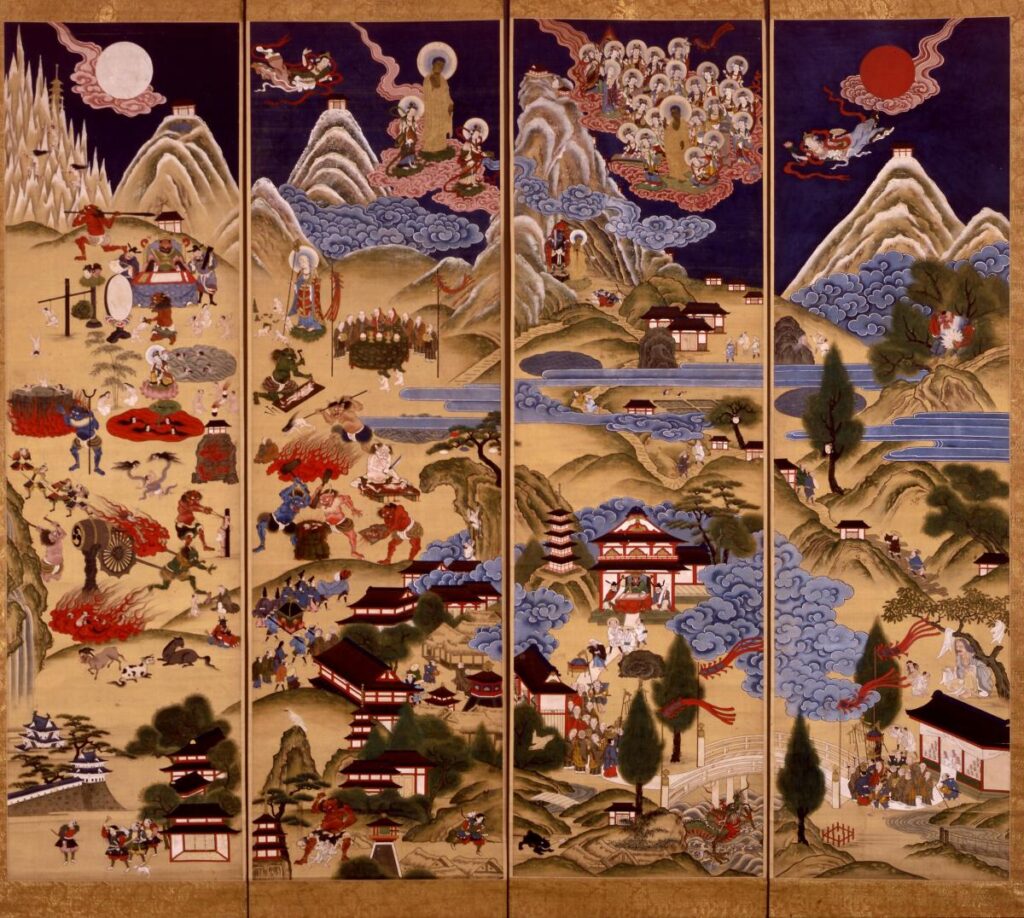
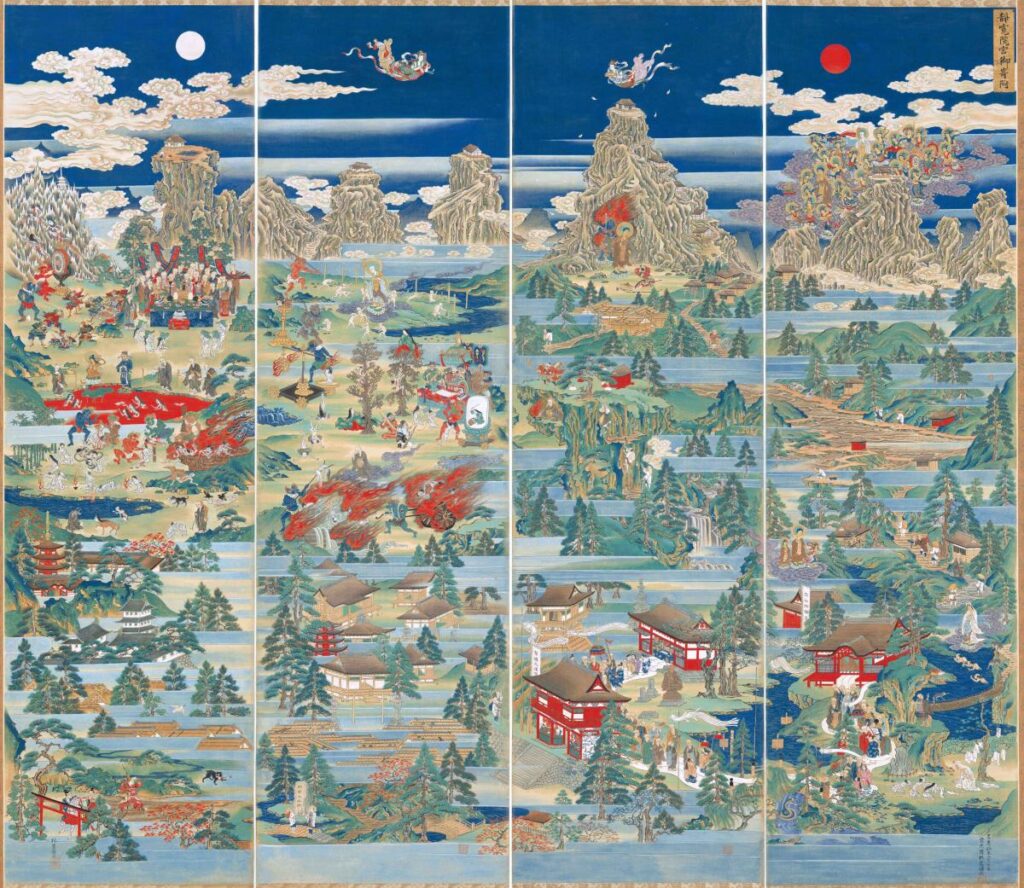
The Tateyama Mandala is a religious painting created to spread faith in Mount Tateyama and encourage pilgrimage to the sacred peak. About 54 are known today, most from the Edo period (1603–1868), with 11 designated as Important Tangible Folk Cultural Properties.
In the past, priests from Ashikuraji and Iwakuraji carried these paintings to villages during the farming off-season. They hung them in homes or temples and used etoki—storytelling through pictures—to share the teachings and wonders of Tateyama.
Originally made as large foldable paper panels, the mandalas later evolved into scroll paintings, easier to carry and display. Many surviving examples are sets of four scrolls forming one grand scene, though others vary in number and design.
No two mandalas are exactly alike. Each has its own subtle differences—an enduring mystery that continues to fascinate scholars and viewers alike.
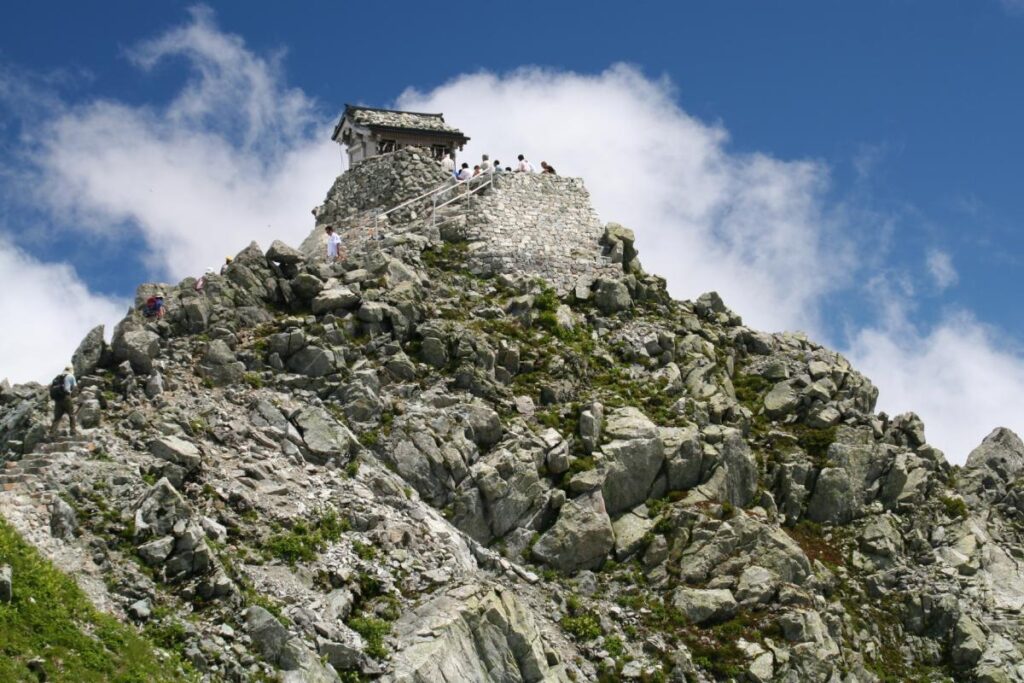
The Main Shrine of Oyama Shrine, located at the summit of Mount Oyama, the main peak of Mount Tateyama
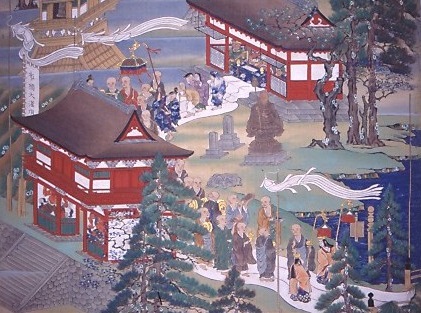
The Tateyama Mandalas bring the sacred mountain range vividly to life. Blending legend, Buddhist cosmology, and local ritual, they portray Tateyama as both a place of fearsome trials and a gateway to salvation. Through five central motifs—from the opening legend of the mountain to visions of hell and paradise, pilgrimage landmarks, and the dramatic Nunobashi ritual—the mandalas invite viewers into a spiritual landscape where the earthly and the divine meet.
The Five Motifs of the Tateyama Mandala
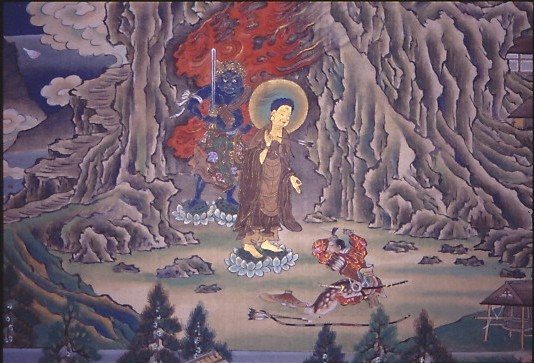
1. The Opening Legend A boy chasing his father’s white hawk met a bear in the mountains. The bear revealed itself as Amida Buddha, inspiring him to become a monk and open Tateyama as a sacred site.
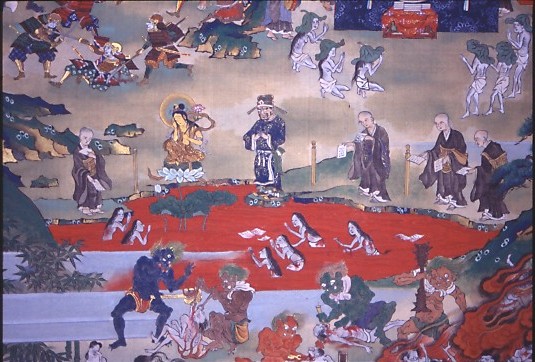
2. The Hells of Tateyama Fiery valleys and the palace of King Enma illustrate the terrifying underworld said to lie within Tateyama’s depths.
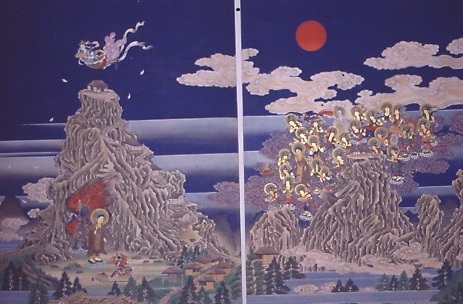
3. The Pure Land From Mt. Jōdo, Amida Buddha and a host of bodhisattvas descend in a radiant vision of salvation.
4. Pilgrimage Landmarks Famous sites along Tateyama’s ancient pilgrimage route, where monks and worshippers sought spiritual awakening.
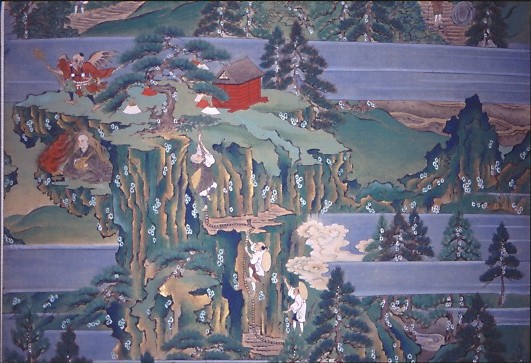
5. The Nunobashi Ritual Held each autumn at Ashikuraji village, women crossed the “Cloth Bridge” in a powerful rite of rebirth and salvation.
Tateyama Mandala-Kichijobo version: Collection of the Tateyama Museum, designated as a National Important Tangible Folk Cultural Property
The Distinctive Nature of Tateyama Faith in Etoki
Priests of Tateyama used mandalas in a storytelling performance called etoki (“pictorial explanation”). At their preaching sites, they narrated tales such as the Legend of Tateyama’s Opening, the Hells and Pure Land of Tateyama, famous pilgrimage landmarks (told mainly by Iwakuraji priests), and the Nunobashi ritual (told mainly by Ashikuraji priests). Through these vivid performances, people across Japan were inspired to make pilgrimages to Tateyama.
By the late Edo period, however, the content of etoki varied widely from one temple lodge to another. Concerned that this caused confusion, a monk named Gensei of Enmei-in at Iwakuraji compiled a script in 1854 to standardize the practice.This suggests that differences in etoki traditions were reflected in the imagery of the mandalas themselves. In this way, the Tateyama Mandalas serve today as invaluable records of the rich spiritual culture of Edo-period Tateyama faith.
The Opening Legend
The Hells of Tateyama
The Pure Land
Pilgrimage Landmarks
In our next installment, we will take a time-traveling journey back to the Nara period (710-794)to explore the early world of Tateyama faith. I hope you’ll continue to follow along.
Written by Yasuhiko Takano, Director of the Toyama Prefectural Tateyama Museum◎ If you’d like to learn more about Tateyama Mandalas, we recommend the illustrated catalog New Comprehensive Guide to Tateyama Mandalas (144 pages, full color, Yen1,800 plus shipping). For purchase details, please contact the Tateyama Museum.
The Nunobashi Ritual
#https://www.yamanohi.net #Toyama Prefectural Tateyama Museum # Mandala#Mountain Faith