
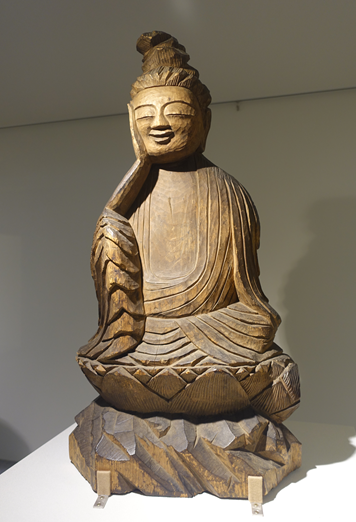
Higashiyama Hakusan Shrine, Takayama City
Episode 2-3
Pilgrimage, Maitreya Faith, and Final Meditation
By Katsuhiro Shimizu
Having completed his ascetic training on Mount Ōmine, Enkū began a new phase of life in the spring of 1676. On one of his statues, he inscribed the words, “A mendicant monk undertaking religious practice throughout Japan.” From this point onward, he embarked upon a life of yugyō—wandering from place to place while carving Buddhist images and engaging in mountain ascetic practice.
He first undertook an astonishingly prolific period of image-making in Owari and Mino Provinces, leaving behind numerous masterpieces. At Arako Kannon Temple, a Tendai temple in present-day Nagoya, he carved monumental guardian statues of the Niō. Using leftover wood chips from this work, he fashioned more than a thousand small images. On the miniature shrine that housed them, he wrote the following poem in ink:
From these discarded and decaying pieces of wood,
I shall create guardian deities
to watch over children.
These words reveal how deeply Enkū cared for the protection and welfare of children.
Through his training on Mount Ōmine, Enkū had become increasingly devoted to the teachings of Tendai Buddhism, particularly to the Lotus Sutra, which proclaims the ideal of kaijō-butsudō—the belief that all people, including women and children, can ultimately attain Buddhahood. In 1679, when he was about forty-eight years old, he formally received ordination at Onjō-ji, the head temple of the Jimon branch of Tendai Buddhism.
The Jimon branch was unique in combining the study of both Buddhist doctrine and Shugendō, and Onjō-ji itself had long maintained deep ties with mountain ascetic traditions.
From 1679 to 1682, Enkū traveled extensively throughout eastern Japan, carving Buddhist images while visiting many sacred mountains of the Kantō region. In particular, inscriptions on his statues record that he undertook an extended retreat of 120 days on Mount Nikkō, one of Japan’s most important sacred mountains.
After returning from the Kantō region, Enkū entered Hida Province, corresponding to present-day northern Gifu Prefecture. He visited Hida during two periods: first between approximately 1685 and 1687, and again in 1690 and 1691, when he was in his mid-fifties to sixty years of age. Throughout Hida, Enkū left behind an extraordinary number of sculptures, while at the same time challenging one mountain after another in relentless ascetic practice.
Enkū’s final journey to Hida took place in 1691. A particularly large concentration of his statues remains in the southern part of the region, on the southwestern slopes of Mount Norikura. During this visit, he carved an image of Śākyamuni Buddha bearing on its reverse side the inscription Shussan Shaka Nyorai (“Śākyamuni Emerging from the Mountain”).
In Buddhist iconography, Shussan Shaka refers to the Buddha descending from the mountains in disappointment after realizing that extreme ascetic practices that merely torment the body cannot lead to true enlightenment. For Enkū, who had devoted much of his life to rigorous mountain asceticism, such a title was highly unusual. In that year, Enkū was sixty years old. Although his spirit may still have aspired to greater heights, it is possible that his body, worn down by decades of severe ascetic training, had finally reached its limits.
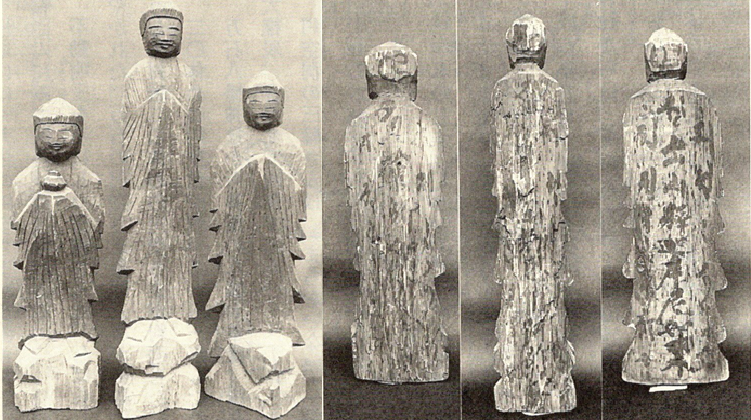
Shakyamuni Buddha after Emerging from the Mountains. Of the three statues preserved at Oze Hakusan Shrine, the figure on the left is a standing Shakyamuni Buddha. The inscription on its back reads “Shussan Shakamuni Nyorai” (Shakyamuni Buddha Emerging from the Mountains).
Source: Asahi Village History Compilation Committee, ed., History of Asahi Village.
After returning to Mino Province, Enkū entered what is believed to have been his final period of religious practice on Mount Kōka (1,224 m). He felt a deep devotion to Mine Chigo-gū, a shrine on the mountain dedicated to a deity believed to protect children, and he left behind many poems devoted to this sanctuary.
Born in the flood-prone land between the Kiso and Nagara rivers, Enkū had witnessed the deaths of countless people, especially children of his own age, caused by repeated floods. During his travels as well, records such as his notes on pulse diagnosis suggest that he frequently encountered the deaths of children and their mothers and offered prayers for them.
The gentle smiles found on Enkū’s statues are therefore more than simply charming or endearing. They were born out of profound compassion shaped by immeasurable sorrow and suffering.
At Kōka Shrine, at the foot of Mount Kōka, Enkū left behind what may be regarded as the crowning achievement of his life: a remarkable group of large-scale sculptures. Among them was an image of Kangi
ten (the Buddhist deity of bliss and prosperity, often identified with a dual-bodied form of Ganesha), a deity believed to possess powerful spiritual efficacy, on whose pedestal Enkū carved the words, “Kama masani nyujo nari “ (“I too shall enter eternal meditation”). Thereafter, all records concerning him cease for three years, leading scholars to believe that he entered his final thousand-day retreat.
Looking back upon Enkū’s life, one finds two distinct but complementary aspects of his faith. In his efforts to save people, he revered the Lotus Sutra and the Great Perfection of Wisdom Sutra, creating images centered on Kannon Bodhisattva, who manifests in countless forms to save all sentient beings according to their needs. On the other hand, throughout his lifelong mountain practice—undertaken to cultivate the spiritual qualities necessary to save others—Enkū remained devoted to Maitreya Bodhisattva. Mount Ibuki and Mount Ōmine were both mountains associated with Maitreya worship; the principal deity of Onjō-ji Temple is Maitreya; and the temple Enkū restored on the banks of the Nagara River and made his own residence was likewise named Miroku-ji (Maitreya Temple).
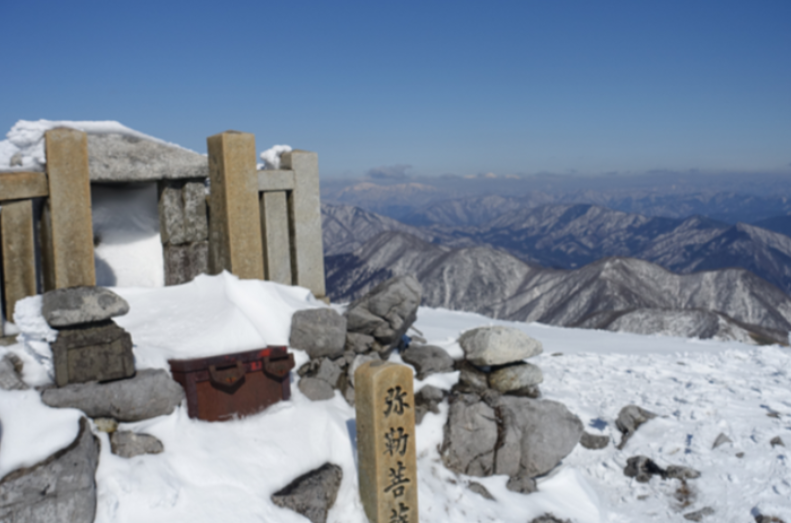
The summit of Mount Ibuki. Even today, a stone hall dedicated to Maitreya remains on the summit, from where one can gaze across to Mount Hakusan and the mountains of the Hida Range that Enkū himself once challenged.
Maitreya Bodhisattva is the bodhisattva destined to become the next Buddha after Śākyamuni. According to Buddhist belief, Maitreya will attain enlightenment and appear in this world 5.67 billion years after the passing of Śākyamuni, saving innumerable sentient beings in three great assemblies.
It may be that Enkū restored Miroku-ji in his later years not merely as a place in which to reside, but because, having pushed both sculpture and mountain asceticism to their utmost limits, he wished to continue protecting people with his very being until the coming age of Maitreya.
In 1695, at the age of sixty-four, Enkū is said to have entered nyūjō—eternal meditation—on the banks of the Nagara River near Miroku-ji Temple.
Note: Nyūjō literally means “entering meditation” and refers to attaining a state of profound spiritual absorption, free from all worldly thoughts. The term is often used to describe the death of eminent Buddhist monks. Kūkai (774–835), founder of Shingon Buddhism and one of Japan’s most revered religious figures, is also believed to have entered nyūjō. According to tradition, he transcended the boundary between life and death and remains in eternal meditation at his mausoleum in Okunoin on Mount Kōya, awaiting the future appearance of Maitreya while continuing to work for the salvation of all beings.
#Japan Mountain Day Foundation
#Enku
#Shugendo
#Hida#Gifu Prefecture
